
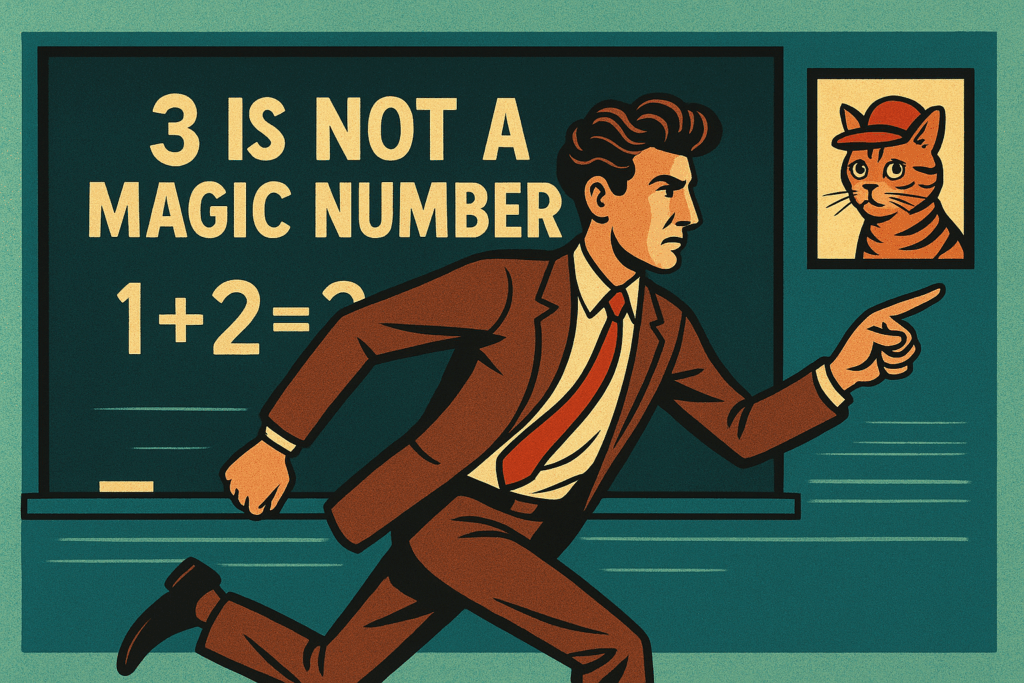
Somewhere between ancient Greece and Schoolhouse Rock! the number three got knighted as “the magic number.” Not by mathematicians, mind you, they were too busy arguing about prime factors and eating chalk dust, but by storytellers, advertisers, and pop culture grifters who figured out something deep about the human brain: you will remember exactly three things and then your skull shuts the door.
It’s why your childhood was a revolving door of Three Little Pigs, Three Musketeers, and Three Stooges. It’s why you still vaguely think genies hand out three wishes, not two or four. And it’s why politicians and marketers love giving you “three reasons why…” before your attention span collapses like a bad soufflé.
Pythagoras Did It First (and He Was Weird About It)
Ancient Greek math cult leader Pythagoras thought numbers had personalities. Three, in his view, was balance, harmony, and perfection. A cosmic tripod holding up the universe. This is also the man who wouldn’t eat beans, so take his mystical pronouncements with the same grain of salt you’d give your uncle’s Facebook rants.
The Latin Flex –
Omne Trium Perfectum
By the Roman era, “everything that comes in threes is perfect” had gone mainstream. Orators used it, poets used it, even gladiators probably yelled “three hits!” before stabbing someone for the third time. The rule of three became an unshakable design principle long before UX designers in black turtlenecks pretended they invented it.
Schoolhouse Rock! Weaponized It
Fast-forward to the early ‘70s: advertising exec David McCall decides kids can’t memorize multiplication tables. He hires jazzman Bob Dorough to sing them into submission. The pilot episode of Schoolhouse Rock! drops Three Is a Magic Number in 1971. Suddenly, every kid in America knows their 3-times table and hums it while eating sugary cereal shaped like cartoon marshmallows.
De La Soul Brings It to the Streets
In 1989, hip-hop trio De La Soul resurrects the line for The Magic Number on their debut 3 Feet High and Rising. Now the phrase has a street pass you can quote it at both a PTA meeting and a block party without sounding completely out of place.
But Here’s the Thing…
Ask an actual mathematician if 3 is “the magic number” and they’ll say “no” without blinking. In math, “magic number” is reserved for nuclear shell models, magic squares, and other dry things nobody puts on T-shirts. Which is fine because if mathematicians were in charge of branding numbers, π would have its own late-night infomercial and imaginary numbers would have their own dating app.
So Is Three Magical?
In culture, yes. In strict math, not really. In your brain, absolutely. We’re wired to love threes because they’re just enough to feel complete but not enough to overwhelm. The marketing world knows it. Storytellers know it. Ancient bean-hating math cultists knew it.
And if your teacher says otherwise? Smile politely. Then give them three reasons why they’re wrong. Because deep down, they already know.