
Ernie, the Fastest Milk Float in the West

We’ve officially named the Hyundai Ioniq 6.

Meet Ernie.

Because when you’re gliding down the freeway in an appliance-shaped spaceship that can out-drag an 80’s Ferrari, it feels right to give it a daft name. And “fastest milk float in the west” just fits.

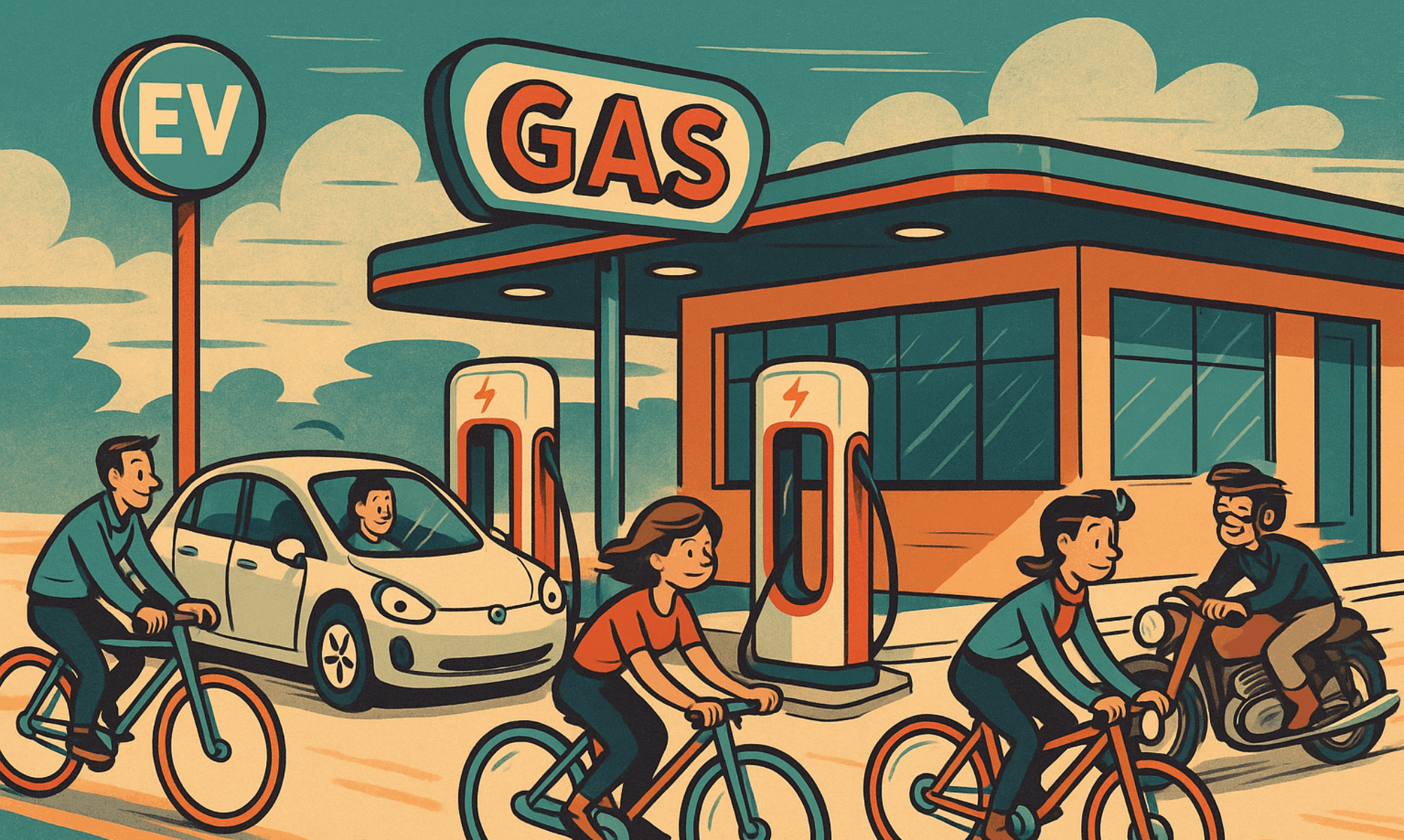
This was the first proper road trip in Ernie. Up until now, the farthest we’d gone was a few hours from home, mostly topping up at familiar chargers. Which got me thinking: did we even need the NACS (Tesla) adapter? For months I carried it around like a lucky rabbit’s foot, plugged it in once to check it worked, and otherwise wondered if it was just an overpriced piece of plastic.

Spoiler: yes, you need it.

CCS vs. NACS: the plot twist

Here’s what I’ve learned.

CCS is faster, on paper. I’ve hit speeds over 200kW on Electrify America’s 350kW stations. Watching the numbers climb feels like winning a slot machine pull.

There’s decent coverage with ChargePoint, EVgo, and other DC fast chargers. But most of these sit in the 50kW zone. Translation: ~35kW real world. Good enough if you’re parked at Trader Joe’s buying frozen dumplings, but painful if you’re just trying to pit-stop and get moving again.

Freeway pit stops = EA or bust. The 200–350kW posts along I-15 and Walmart supercenters are where the real road-trip speeds happen.

Reliability roulette

This is where it gets messy.

Shell Energy? Hit or miss. More often miss.

Other networks? You absolutely need to check the app. Pro tip: if nobody’s checked in within the last 24 hours, assume that charger is a zombie. Lights on, nobody home.

Tesla: reliable but slower

The big surprise? Tesla’s chargers work. They may not always be in the nicest parts of town (several felt like the landlord cleared out a homeless camp, dropped in some chargers, and called it a day), but the things just fire up and charge. Every time.

The catch: they’re capped. Ernie only sips around 97kW from Tesla’s 400V Superchargers. Compare that to 200+ on CCS and you feel the drag. Still, in the world of EV road-tripping, reliability counts for more than bragging rights on a graph.

The fine print on Tesla chargers

• Not all Superchargers are open to non-Tesla cars yet.

• Larger sites may be split into “phases.” Translation: one row works with Ernie, the other row doesn’t. If your stall’s dead, don’t panic—drive across the lot and try the other bank.

• Definitely set yourself up in the Tesla app before you leave. Nothing like fumbling with account setup on the side of the freeway while your family judges you.

Verdict

No regrets on buying Ernie. The Ioniq 6 is smooth, efficient, and—yes—an actual milk float with attitude.

The Tesla adapter? Essential. Not because it’s the fastest, but because when every other charger’s down and you’re staring at a map full of offline icons, the Teslas are humming away in the background, smug as ever.

And that’s the reality of EV road-tripping right now: it’s less about max kilowatts and more about what actually works.

👉 Next up: Ernie vs. mountains. How does he handle the uphill battery drain and the downhill regen game? Stay tuned.


Turn On Your Damn Camera (and Fix Your Glasses)

It’s been a long, weird battle in the trenches of remote work. Remember those giant company-wide Zoom meetings back in 2020? Everyone sat there glued to their Brady Bunch squares, pretending to be laser-focused while the world burned outside and half the company wondered if they were about to get axed.

Funny thing is, getting axed wasn’t always a bad deal. Some folks landed those “sorry, we’re restructuring” severance packages and walked straight into another gig with a $20k raise and a manager who doesn’t care if they answer Slack at 10 a.m. or 10 p.m. Living the dream, really.

And then there was that Customer Success Manager, the legend who decided showing up to work was optional if you had enough creativity and a webcam. He recorded himself sipping coffee at perfectly timed 2-minute-and-17-second intervals, looped the footage, and slapped it up as his Zoom background. Genius, right? Almost. Because Maggie in HR watches gallery view the way hawks watch field mice. By the second meeting she noticed the same sip, same blink, same nod, cycling like a busted cuckoo clock. By the third, she had a stopwatch out. By the fourth, the loop boy was gone.

Now here we are, years later, and Zoom culture is still a hot mess. Cameras went dark, people disappeared behind avatars and blurry backgrounds. Meetings started sounding like séances: “Is Jim even here? Knock once if yes.”

But lately the pendulum swung back. Cameras are on again. Great, right? Except now I don’t actually see you. I see Joe Rogan’s latest podcast episode reflected crystal-clear in your lenses.

So here’s my unsolicited workplace PSA:

Turn on your damn camera.

Invest in glare-free, anti-reflective glasses.

And for the love of all that is caffeinated—don’t try to video-loop your way through life.

Because yes, I want to see your face. But no, I don’t want to watch your infinite coffee loop while pretending to listen to Q3 strategy updates.

Welcome to remote work in 2025. Same circus, slightly better optics.

Three Is the Magic Number – And Your Teacher Is Lying to You

Somewhere between ancient Greece and Schoolhouse Rock! the number three got knighted as “the magic number.” Not by mathematicians, mind you, they were too busy arguing about prime factors and eating chalk dust, but by storytellers, advertisers, and pop culture grifters who figured out something deep about the human brain: you will remember exactly three things and then your skull shuts the door.

It’s why your childhood was a revolving door of Three Little Pigs, Three Musketeers, and Three Stooges. It’s why you still vaguely think genies hand out three wishes, not two or four. And it’s why politicians and marketers love giving you “three reasons why…” before your attention span collapses like a bad soufflé.

Pythagoras Did It First (and He Was Weird About It)

Ancient Greek math cult leader Pythagoras thought numbers had personalities. Three, in his view, was balance, harmony, and perfection. A cosmic tripod holding up the universe. This is also the man who wouldn’t eat beans, so take his mystical pronouncements with the same grain of salt you’d give your uncle’s Facebook rants.

The Latin Flex – 

Omne Trium Perfectum

By the Roman era, “everything that comes in threes is perfect” had gone mainstream. Orators used it, poets used it, even gladiators probably yelled “three hits!” before stabbing someone for the third time. The rule of three became an unshakable design principle long before UX designers in black turtlenecks pretended they invented it.

Schoolhouse Rock! Weaponized It

Fast-forward to the early ‘70s: advertising exec David McCall decides kids can’t memorize multiplication tables. He hires jazzman Bob Dorough to sing them into submission. The pilot episode of Schoolhouse Rock! drops Three Is a Magic Number in 1971. Suddenly, every kid in America knows their 3-times table and hums it while eating sugary cereal shaped like cartoon marshmallows.

De La Soul Brings It to the Streets

In 1989, hip-hop trio De La Soul resurrects the line for The Magic Number on their debut 3 Feet High and Rising. Now the phrase has a street pass you can quote it at both a PTA meeting and a block party without sounding completely out of place.

But Here’s the Thing…

Ask an actual mathematician if 3 is “the magic number” and they’ll say “no” without blinking. In math, “magic number” is reserved for nuclear shell models, magic squares, and other dry things nobody puts on T-shirts. Which is fine because if mathematicians were in charge of branding numbers, π would have its own late-night infomercial and imaginary numbers would have their own dating app.

So Is Three Magical?

In culture, yes. In strict math, not really. In your brain, absolutely. We’re wired to love threes because they’re just enough to feel complete but not enough to overwhelm. The marketing world knows it. Storytellers know it. Ancient bean-hating math cultists knew it.

And if your teacher says otherwise? Smile politely. Then give them three reasons why they’re wrong. Because deep down, they already know.

“Men in Tight Pants: How America Marketed a 9-Year-Old Girls’ Sport to Grown Men in Cubicles”

Baseball, its a girls game called rounders played by nine year old girls in England

Every time I step into an office, it’s like walking into a clubhouse of unpaid benchwarmers. Middle aged men in polo shirts huddle together, recounting last night’s “performance” like they’d just walked off the field themselves, rather than waddled from the fridge to the couch, chewing through nachos at a rate that would make a ballpark seagull blush.

They don’t talk about watching the game. No. In their heads, they played it. They got the home run. They slid into third. They “gave it 110%.” And of course, they are also the proud owners of $90 polyester shirts stitched in Bangladesh, bought to prove allegiance to the millionaire strangers who don’t know they exist.

The Ingenious (and Slightly Creepy) Origins

Now, to give credit where it’s due, the marketing brains behind modern baseball pulled off something almost un-American in its efficiency: they took a slow, pastoral sport, and sold it to people with the attention span of a beer commercial.

The trouble? Baseball started life as a nine-year-old girls’ summer pastime. Think picnic blankets, warm lemonade, and cricket bats swapped for something easier to swing. But the suits in the early 20th century saw potential… if they could just fix three small problems.

1. The Nine-Year-Old Girl Career Ceiling

Turns out, building an entire sports league around pre-teens is tricky. By the time you’ve hyped up your star player, she’s aged out, gone goth, and started a zine about hating gym class.

American marketing needed lifelong athletes who could still perform into their 30s, ideally with the stamina to run 90 feet once every ten minutes without collapsing.

2. Merchandising That Wouldn’t End Up on a Police Report

Selling small girls’ uniforms to grown men? Yeah… someone in the boardroom said, “We’d better not.” They learned quickly that creepy merchandise markets are best left to shady politicians and their friends with private islands. Instead, they rebranded the uniforms onto burly men with forearms like ham hocks, and voilà, the pedophile problem solved.

3. Fixing Cricket’s Fatal Flaw

Cricket — baseball’s boring older cousin, already had the lethargic pacing nailed. But Americans wanted coliseum flair. The marketing fix was simple: smaller field, more steroid-fed athletes, and the occasional fight. Same nap-friendly pace, but now with the threat of someone pulling a muscle live on camera.

The result? The perfect office sport.

A pastime that’s just engaging enough for a couple of minutes every half hour, yet slow enough that a man can watch an entire game and still write three emails, take a bathroom break, and microwave lunch without missing a single moment of “the action.”

So yes, baseball marketing men did something good. Not in the wholesome sense, but in the you accidentally invented a money-printing machine sense. And now, decades later, America’s cubicles are filled with armchair MVPs, proudly recounting the night’s game like they were on the roster, blissfully unaware that they’re just extras in a sport’s century-old marketing campaign.

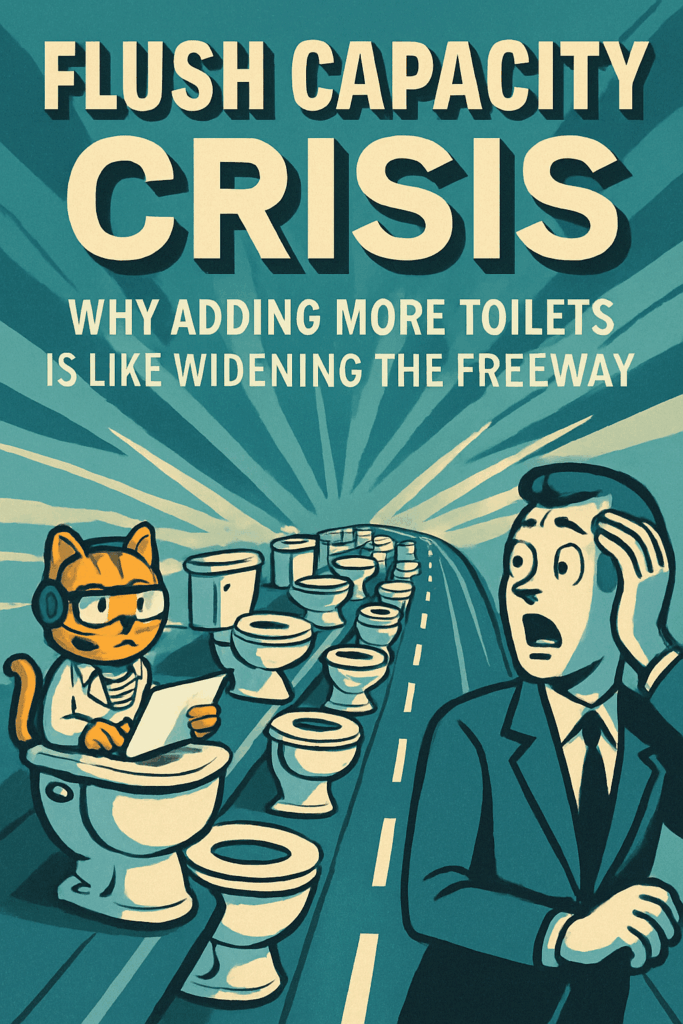
Flush Capacity Crisis: Why Adding More Toilets Is Like Widening the Freeway

By the Deathjuice Editorial Brigade

Bathrooms are like freeways. And no, we’re not just saying that because we spend half our lives in traffic and the other half sprinting to find a clean stall.

Let’s break it down.

Each toilet is a porcelain throne, a gleaming lane in the great highway of humanity’s biological schedule. And just like the Department of Transportation, some facilities try to solve the issue of congestion by adding more lanes—err, stalls.

More thunder boxes must mean less wait time, right?

Wrong.

What we’ve witnessed in the wild—at festivals, skateparks, rec centers, and even that one suspicious gas station with a Bluetooth speaker in the ceiling—is that the more toilets you add, the more people show up to poop. It’s like there’s some psychic plumbing hotline telling the masses, “Hey, there’s an open stall in the northeast quadrant. Drop everything.”

Like freeways, expanding bathroom capacity doesn’t reduce demand—it just invites a fresh surge of urgent travelers to the bowl-based bottleneck. First world problem? Absolutely. But it’s also a real one. Because nothing ruins your chill like a full bladder and a locked stall with someone’s cargo ship still mid-dock.

The result? A game of chicken with human dignity.

An arms race of cheeks versus seats.

A logistic nightmare painted in graffiti and half-used toilet paper rolls.

So what’s the solution?

We don’t know. But we do know that Kevin the cat from triage would have flagged this case as critical.

🧻 Deathjuice: reporting from the front lines of stall warfare since forever.