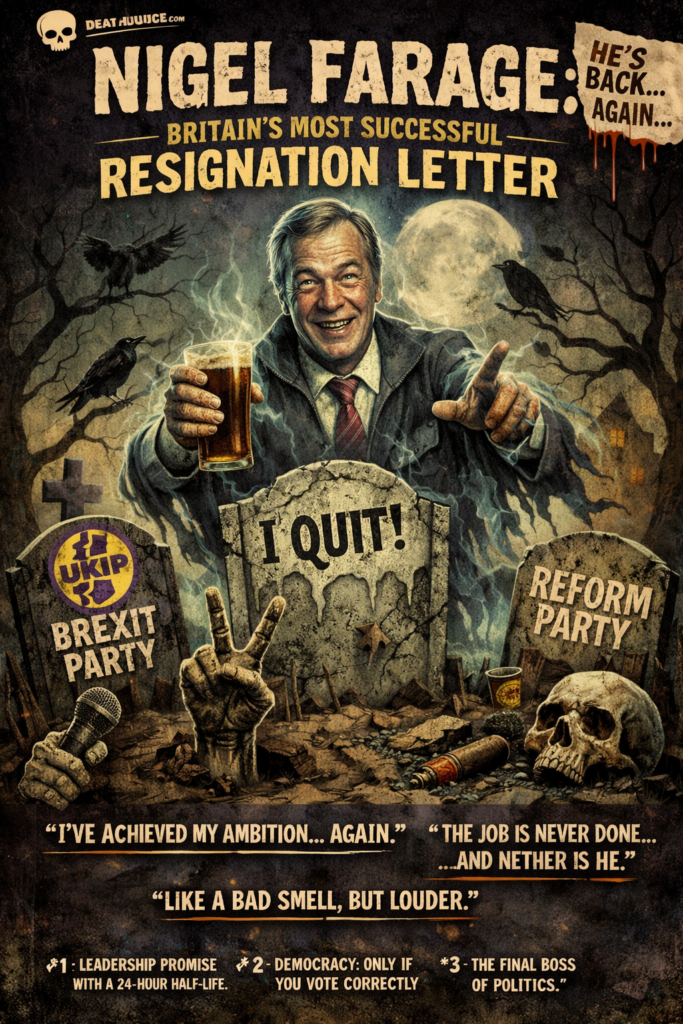
Nigel Farage: The Man Who Keeps Resigning From the Same Job He Never Leaves

Nigel Farage is Britain’s most persistent pop-up notification.

You close it. You uninstall it. You factory-reset the country.

And somehow, there it is again:

“Nigel Farage has returned.”

He’s not a politician so much as a political haunting the spirit of a pub argument that refuses to move on after last orders.

UKIP: The First Resurrection

Farage’s original trick was UKIP: a party built entirely out of resentment, laminated newspaper headlines, and the belief that the EU personally stole your pint.

He didn’t lead UKIP so much as wear it like a coat, taking it off whenever responsibility appeared.

  • Resign.
  • Come back.
  • Resign again.
  • Come back louder.

Like a man repeatedly storming out of the pub only to re-enter through a different door shouting “AND ANOTHER THING”

Brexit: The Job Was Done (Apparently)

Then came Brexit.

The big one.

The whole point.

Farage stood tall, victorious, and announced:

“My political ambition has been achieved.”

And then he resigned.

Which, in hindsight, should have been treated with the same seriousness as a smoker saying “this is my last cigarette.”

Because once the vote was won, Farage did what all great revolutionaries do:

He immediately found a new revolution.

The Forever Afterparty

Brexit wasn’t an ending. It was a franchise.

Nigel didn’t ride off into the sunset he stood in front of it explaining that the sunset was fake, the sun was EU-controlled, and actually we need a new party to deal with this.

So we got:

  • Brexit Party
  • Reform
  • Whatever branding exercise happens next

Different logo. Same rage. Same man. Same speech.

Like a tribute band that insists it’s the real thing.

Resignation as a Brand Strategy

Farage resigns the way normal people take holidays.

Each resignation is framed as:

  • Noble
  • Final
  • Definitely permanent this time

Until the camera turns on, a microphone appears, or someone says “establishment elites” three times into a mirror.

Then he’s back.

Tanned. Smiling. Furious.

Claiming he never wanted power while holding it with both hands.

Nigel Farage Is Not Leaving Politics

He is becoming politics’ background radiation.

You don’t vote for him — you measure him.

You don’t elect him — you detect him.

Long after the causes are forgotten, Farage will still be there explaining that the real betrayal hasn’t happened yet, but oh boy, it’s coming.

In Conclusion

Nigel Farage didn’t finish his mission with Brexit.

He finished Act One.

And like all great villains, he keeps returning to remind us:

The fight is never over.

The resignation is never real.

And the pub argument must go on forever.

Because if Nigel Farage ever truly left politics,

he’d have to finally admit the worst possible thing:

That the country moved on —

and he didn’t.
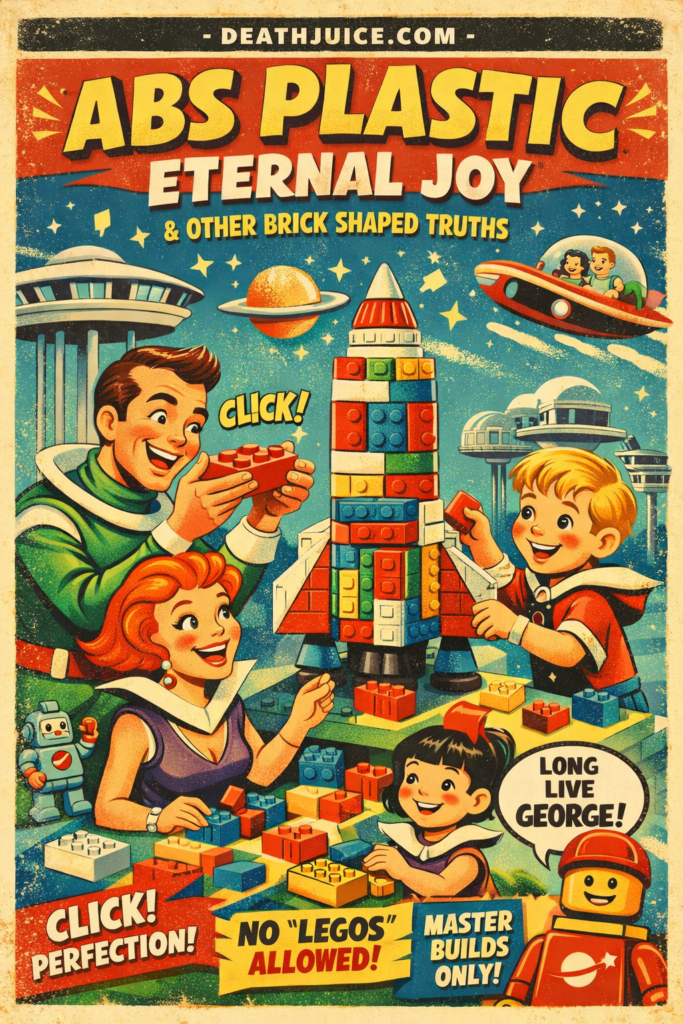
ABS Plastic, Eternal Joy, and Other Brick Shaped Truths

There are very few universally agreed upon pleasures left in this broken world. A perfectly toasted Pop Tart. The cold side of the pillow. And that sound, that sound, when two LEGO bricks connect.

That crisp, confident click.

Not a mush. Not a maybe.

A click that says yes, this was meant to be.

Scientists have wasted decades smashing atoms together when the real proof of intelligent design has been sitting on bedroom floors since 1958.

The Click Is Pure Dopamine

Let’s start here. LEGO didn’t just design a toy, they engineered a controlled micro dose of happiness. That click is a promise. A contract. A tiny plastic handshake between bricks saying we are now stronger than we were apart.

Therapy costs money. LEGO bricks just snap together and whisper it’s going to be okay.

Stud Direction: Two Ways Is Acceptable. Four Ways Is Chaos.

Now let’s address the sickness we don’t talk about.

Stud alignment.

Is it necessary to ensure every LEGO logo faces the same direction? No.

Is it morally correct? Absolutely.

There are two acceptable orientations. Forward and backward.

Left and right is where society collapses.

If your build has studs facing all four directions, I’m not saying you’re a bad person, but I am saying I don’t trust you with scissors or government responsibilities.

There Are No Illegal Building Techniques

Unless You Go Full Jackass

LEGO “AFOL’s” keep saying illegal building techniques.

No.

There are only building techniques LEGO “AFOLs” have not emotionally processed yet.

Unless, unless, you’re out here spackling bricks together like it’s a Jackass movie and someone just yelled roll camera. If glue enters the chat, you are no longer building LEGO. You are committing a crime against plastic.

Superglue is not a technique.

It’s a cry for help.

Recycling LEGO Is the Dumbest Take of the Decade

Why is the LEGO Group worried about recyclable bricks?

Sir.

Madam.

Plastic Overlords.

There are LEGO bricks currently in circulation that are older than most governments. These things don’t die. They migrate.

A brick is born in 1974.

It survives three divorces.

It resurfaces in a nephew’s MOC in 2025.

LEGO recycling is not melting bricks down.

It’s moving them from one floor to another, usually barefoot at 2:13 a.m.

“Legos” People Should Be Banned

Let’s be clear.

If you say Legos, you should be gently but firmly escorted out of every LEGO store worldwide and placed on a watch list that prevents entry to LEGOLAND.

It’s LEGO.

Plural LEGO.

This is not hard.

We don’t say sheeps.

We don’t say mooses.

And we do not say Legos.

That TV Show Name Is Still Trash

The show is not called Master Builder.

And that’s a tragedy.

Instead we got something that sounds like a corporate team building exercise where Kevin from accounting cries in the bathroom.

Call it Master Builder.

Let children dream.

Let adults feel powerful.

Pick A Brick Always Smells Weird

Every LEGO store has that smell near Pick A Brick.

If there’s an AFOL nearby, the smell intensifies.

I don’t know why.

Science doesn’t know why.

The bricks know.

It’s a mix of anticipation, polyester cargo shorts, and destiny.

LEGO Was Better in the 1970s

Back when colors were honest.

Red.

Blue.

Yellow.

Black.

White.

Now we’ve got dark bluish gray and slightly sad sand tan.

I don’t need fourteen shades of regret.

I need bricks that commit.

Long Live George

If you know, you know.

And if you don’t,

you’re not ready.

Final Click

LEGO is not a toy.

It’s a philosophy.

A religion.

A pile of plastic that has ruined more bare feet than war.

And we wouldn’t have it any other way.

Click

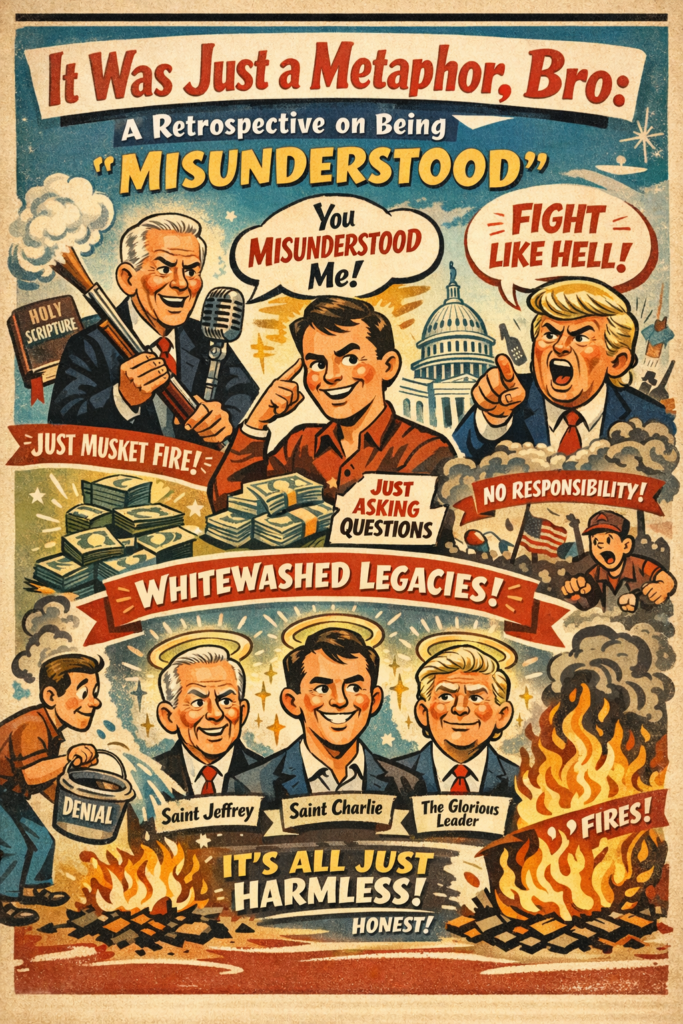
It Was Just a Metaphor, Bro: A Retrospective on Violence, Amnesia, and the Art of Being ‘Misunderstood’

There’s a very specific genre of public figure who loves inflammatory language the way toddlers love light switches: flip it on, watch what happens, deny responsibility, repeat.

You know the type.

They don’t say “hurt people.”

They just borrow the vocabulary of war, sprinkle it over social grievances, and then act shocked—shocked—when someone bleeds.

And when consequences arrive?

Oh no. No, no, no.

You misunderstood them.

It was a metaphor.

The Musket Fire School of Rhetoric

Take the now-infamous “musket fire” moment. A religious leader, speaking to a crowd trained from birth to treat his words as divinely adjacent, invoked violent imagery aimed squarely at the LGBTQ community.

But relax.

He didn’t mean violence.

He just chose:

• Weapons

• Ammunition

• Battle language

• And a marginalized target

In a country where mass shootings are as American as fast food regret.

Totally symbolic.

Purely poetic.

Just vibes.

When critics objected, defenders rushed in like volunteer janitors at a crime scene:

“He didn’t mean actual musket fire.”

Cool. Then why not say “firm disagreement,” “doctrinal boundaries,” or “please stop asking us uncomfortable questions”?

Why reach for 19th-century murder tools if you’re just hosting a book club?

The ‘I Didn’t Say That, I Just Repeated It Loudly’ Strategy

Then there are the professional culture warriors—the podcast princes, the megaphone philosophers—who spend hours ranting about entire racial groups, intelligence, worth, and hierarchy.

But again: misunderstanding.

They weren’t saying Black people are less intelligent.

They were just:

• Asking questions

• Exploring ideas

• Repeating long-debunked racist talking points

• Monetizing outrage

And when someone points out that dehumanizing rhetoric historically leads to—you know—actual harm?

Whoa, whoa, whoa.

Why are you being so divisive?

‘Fight Like Hell’ and Other Totally Peaceful Suggestions

And of course, the gold standard.

A president tells supporters to:

• March

• Take their country back

• Fight like hell

Right before a violent mob does exactly that.

But listen closely—he didn’t mean fight.

He meant:

• Cheer aggressively

• Democracy, but louder

• Patriotism with light trespassing

• A completely nonviolent event featuring gallows and zip ties

When it goes bad, suddenly everyone’s hard of hearing.

“Those were just words.”

Funny how words are powerful enough to win elections, radicalize millions, and generate fundraising emails—but become harmless air the moment someone gets hurt.

The Posthumous Car Wash

Now here’s the magic trick.

Some of these men are gone now.

And wouldn’t you know it? Their legacies have been run through the deluxe memorial rinse cycle.

• Context removed

• Harm minimized

• Victims forgotten

• Critics labeled “uncharitable”

We’re told to remember their intent, not their impact.

Their heart, not their words.

Their service, not the smoke trail they left behind.

History, apparently, is written by whoever controls the obituary slideshow.

The Eternal Defense: ‘I Was Misunderstood’

Here’s the pattern:

1. Say something explosive

2. Let followers interpret it violently

3. Benefit from the energy, loyalty, and fear

4. Deny responsibility

5. Blame tone, media, or “the left”

6. Eventually die

7. Get canonized

Rinse. Sanctify. Repeat.

At some point, “misunderstood” stops being an explanation and starts being a business model.

Final Thought (Purely Metaphorical, Of Course)

If your message:

• Regularly inspires aggression

• Is defended by people who say “well, technically…”

• And needs a legal team to explain what you really meant

Maybe the problem isn’t the audience.

Maybe it’s that you keep lighting matches in a dry forest and insisting you were just checking the wind.

But don’t worry.

No one’s accusing you of violence.

That would be unfair.

This is just a metaphor.

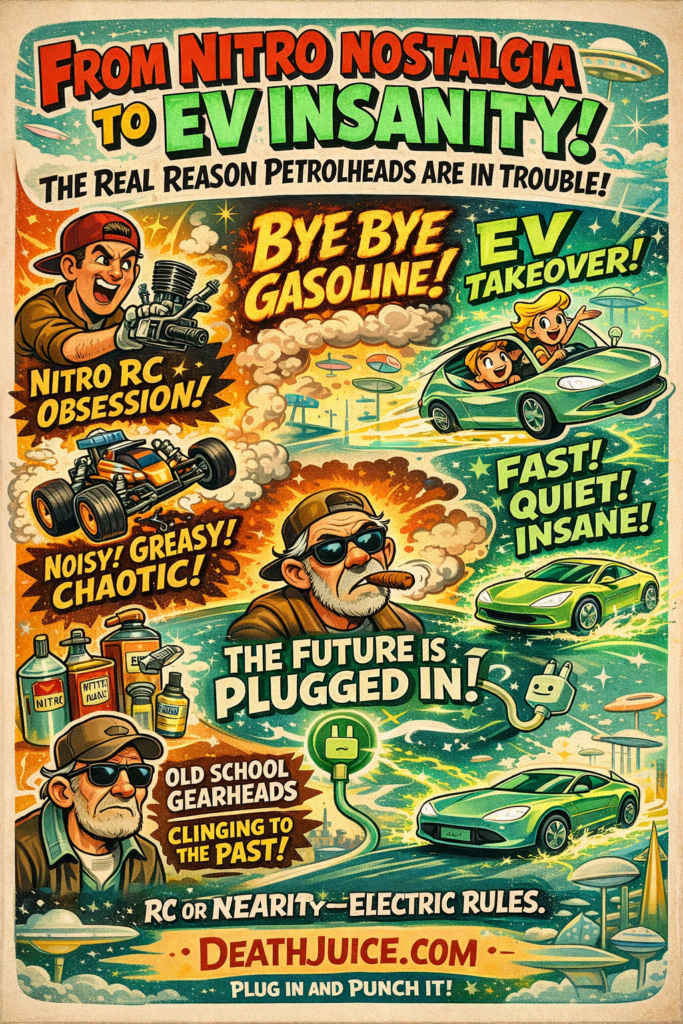
From Nitro Nostalgia to EV Insanity: The Real Reason Petrolheads Are in Trouble

There was a time, in the fluorescent-lit basements of the 80s and early 90s, when racing RC cars was everything. We tinkered with Kyoshos until our cuticles bled, drooled over Team Associated buggies, and showed up to car parks with Tamiya and Schumacher wagons—the batteries barely charged, the excitement at full tilt.

And then came nitro.
Suddenly, electric was “kid stuff.” Nitro was the grown-up’s toy: thunderous, oily, and chaotic. We all bought in. Speed! Noise! The authentic whiff of burning cash and patience! We spent more time wrenching than racing and probably lost a decade of Saturday afternoons to engine tuning, clutch failures, and the gentle art of apologizing to neighbors.

Then, something happened.
We realized fun had left the chat.

Sound Familiar, Gearheads?

Look outside: it’s not just RC cars doing this dance.
Gasoline and diesel ruled the road. Everybody wanted a fuel-burner with horsepower numbers you could brag about. Turbo lag was a badge of honor.
You learned to love the grind—oil changes, timing belts, spark plugs, mind-numbing maintenance every weekend. “It’s part of the ritual,” you told yourself, much like your old RC club’s nitro nuts.

Fast-forward: the world is plugging in and checking out of the internal combustion arms race.
The Tesla S Plaid will beat your vintage GTI from a stoplight. Rivian pickups drift harder than you on Gran Turismo. And just like the RC track, the new electric kids are doing two things that matter most: going faster and having way more fun.

The Old Guard Strikes Back

There’s always a guy clutching the past like a glow-plug wrench—gatekeeping, grumbling about how “real” cars have a clutch pedal (and, presumably, an 8-track and a glovebox full of mixtapes). “It’s about the driving experience,” he insists, somewhere between oil stains and nostalgia.

But open your eyes:

  • Electric RC wasn’t supposed to take over—until it did.
  • Electric cars weren’t “real” cars—until they destroyed everyone’s numbers.
  • The quiet, reliable, insane, plug-n-play fun wins, every time.

Why the Smart Money (and Fun) Is on Electric

  • Maintenance? What maintenance? Plug in. Go. Repeat.
  • Speed? Electric is cheating. Lipo or lithium—it launches like a slingshot and you barely blink before breaking traction.
  • Reliability? Want to race or want to wrench?
  • Joy? Remember that? It’s back.

Sure, there are diehards rewriting the rulebooks to try to keep their old world spinning. But when the world flipped to lipo on the track, and EVs on the street, the game changed. “But the noise!” they wail, tuning their exhausts and their radio to the Oldies. Just like the nitro crowd at club day.

Hey, we love a classic. But nostalgia doesn’t win races.

Conclusion: RC or Reality, Electric Rules

Nitro RC was king—until electric made speed accessible and reliable.
Petrol cars ruled—until EVs made torque instantaneous and maintenance a footnote.

The next car you’ll really want? Probably electric.
Because you’ll be driving, not dreaming, and actually having a blast.

You can cling to the past—or you can discover just how much fun the future really is.

deathjuice.com
If you love fun more than frustration, plug in, and punch it.