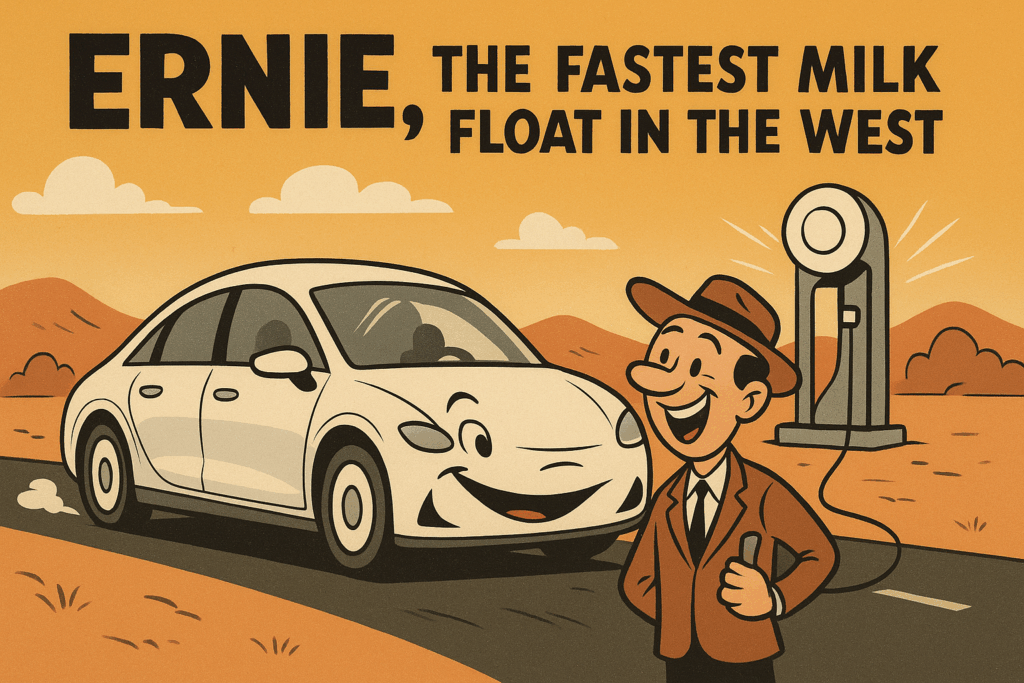
We’ve officially named the Hyundai Ioniq 6.
Meet Ernie.
Because when you’re gliding down the freeway in an appliance-shaped spaceship that can out-drag an 80’s Ferrari, it feels right to give it a daft name. And “fastest milk float in the west” just fits.
This was the first proper road trip in Ernie. Up until now, the farthest we’d gone was a few hours from home, mostly topping up at familiar chargers. Which got me thinking: did we even need the NACS (Tesla) adapter? For months I carried it around like a lucky rabbit’s foot, plugged it in once to check it worked, and otherwise wondered if it was just an overpriced piece of plastic.
Spoiler: yes, you need it.
⸻
CCS vs. NACS: the plot twist
Here’s what I’ve learned.
• CCS is faster, on paper. I’ve hit speeds over 200kW on Electrify America’s 350kW stations. Watching the numbers climb feels like winning a slot machine pull.
• There’s decent coverage with ChargePoint, EVgo, and other DC fast chargers. But most of these sit in the 50kW zone. Translation: ~35kW real world. Good enough if you’re parked at Trader Joe’s buying frozen dumplings, but painful if you’re just trying to pit-stop and get moving again.
• Freeway pit stops = EA or bust. The 200–350kW posts along I-15 and Walmart supercenters are where the real road-trip speeds happen.
⸻
Reliability roulette
This is where it gets messy.
• Shell Energy? Hit or miss. More often miss.
• Other networks? You absolutely need to check the app. Pro tip: if nobody’s checked in within the last 24 hours, assume that charger is a zombie. Lights on, nobody home.
⸻
Tesla: reliable but slower
The big surprise? Tesla’s chargers work. They may not always be in the nicest parts of town (several felt like the landlord cleared out a homeless camp, dropped in some chargers, and called it a day), but the things just fire up and charge. Every time.
The catch: they’re capped. Ernie only sips around 97kW from Tesla’s 400V Superchargers. Compare that to 200+ on CCS and you feel the drag. Still, in the world of EV road-tripping, reliability counts for more than bragging rights on a graph.
⸻
The fine print on Tesla chargers
• Not all Superchargers are open to non-Tesla cars yet.
• Larger sites may be split into “phases.” Translation: one row works with Ernie, the other row doesn’t. If your stall’s dead, don’t panic—drive across the lot and try the other bank.
• Definitely set yourself up in the Tesla app before you leave. Nothing like fumbling with account setup on the side of the freeway while your family judges you.
⸻
Verdict
No regrets on buying Ernie. The Ioniq 6 is smooth, efficient, and—yes—an actual milk float with attitude.
The Tesla adapter? Essential. Not because it’s the fastest, but because when every other charger’s down and you’re staring at a map full of offline icons, the Teslas are humming away in the background, smug as ever.
And that’s the reality of EV road-tripping right now: it’s less about max kilowatts and more about what actually works.
⸻
👉 Next up: Ernie vs. mountains. How does he handle the uphill battery drain and the downhill regen game? Stay tuned.