
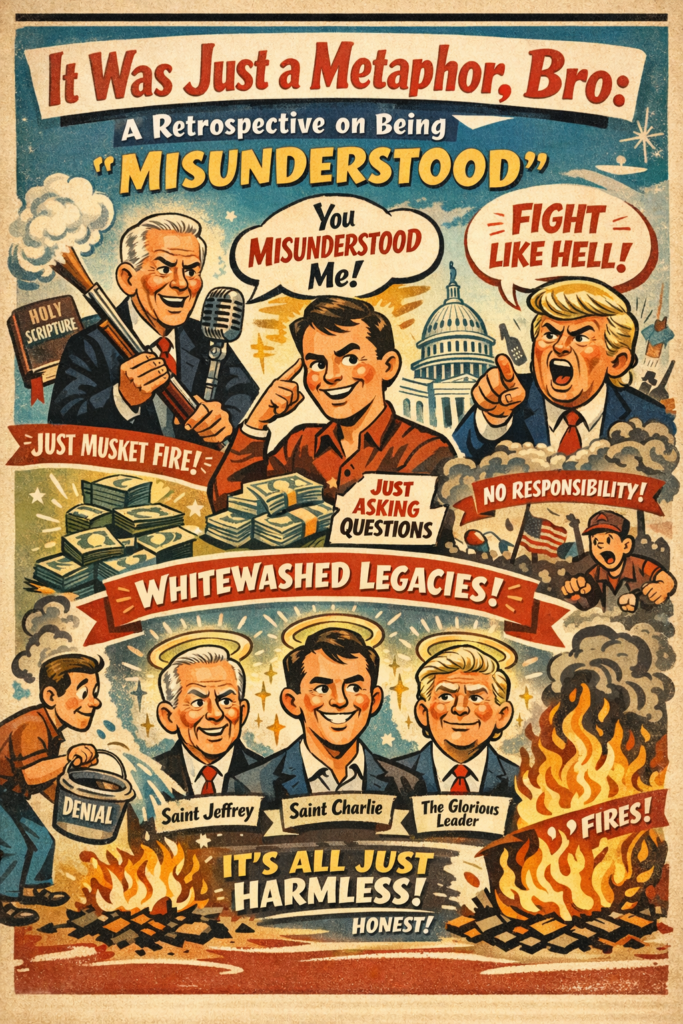
There’s a very specific genre of public figure who loves inflammatory language the way toddlers love light switches: flip it on, watch what happens, deny responsibility, repeat.
You know the type.
They don’t say “hurt people.”
They just borrow the vocabulary of war, sprinkle it over social grievances, and then act shocked—shocked—when someone bleeds.
And when consequences arrive?
Oh no. No, no, no.
You misunderstood them.
It was a metaphor.
The Musket Fire School of Rhetoric
Take the now-infamous “musket fire” moment. A religious leader, speaking to a crowd trained from birth to treat his words as divinely adjacent, invoked violent imagery aimed squarely at the LGBTQ community.
But relax.
He didn’t mean violence.
He just chose:
• Weapons
• Ammunition
• Battle language
• And a marginalized target
In a country where mass shootings are as American as fast food regret.
Totally symbolic.
Purely poetic.
Just vibes.
When critics objected, defenders rushed in like volunteer janitors at a crime scene:
“He didn’t mean actual musket fire.”
Cool. Then why not say “firm disagreement,” “doctrinal boundaries,” or “please stop asking us uncomfortable questions”?
Why reach for 19th-century murder tools if you’re just hosting a book club?
The ‘I Didn’t Say That, I Just Repeated It Loudly’ Strategy
Then there are the professional culture warriors—the podcast princes, the megaphone philosophers—who spend hours ranting about entire racial groups, intelligence, worth, and hierarchy.
But again: misunderstanding.
They weren’t saying Black people are less intelligent.
They were just:
• Asking questions
• Exploring ideas
• Repeating long-debunked racist talking points
• Monetizing outrage
And when someone points out that dehumanizing rhetoric historically leads to—you know—actual harm?
Whoa, whoa, whoa.
Why are you being so divisive?
‘Fight Like Hell’ and Other Totally Peaceful Suggestions
And of course, the gold standard.
A president tells supporters to:
• March
• Take their country back
• Fight like hell
Right before a violent mob does exactly that.
But listen closely—he didn’t mean fight.
He meant:
• Cheer aggressively
• Democracy, but louder
• Patriotism with light trespassing
• A completely nonviolent event featuring gallows and zip ties
When it goes bad, suddenly everyone’s hard of hearing.
“Those were just words.”
Funny how words are powerful enough to win elections, radicalize millions, and generate fundraising emails—but become harmless air the moment someone gets hurt.
The Posthumous Car Wash
Now here’s the magic trick.
Some of these men are gone now.
And wouldn’t you know it? Their legacies have been run through the deluxe memorial rinse cycle.
• Context removed
• Harm minimized
• Victims forgotten
• Critics labeled “uncharitable”
We’re told to remember their intent, not their impact.
Their heart, not their words.
Their service, not the smoke trail they left behind.
History, apparently, is written by whoever controls the obituary slideshow.
The Eternal Defense: ‘I Was Misunderstood’
Here’s the pattern:
1. Say something explosive
2. Let followers interpret it violently
3. Benefit from the energy, loyalty, and fear
4. Deny responsibility
5. Blame tone, media, or “the left”
6. Eventually die
7. Get canonized
Rinse. Sanctify. Repeat.
At some point, “misunderstood” stops being an explanation and starts being a business model.
Final Thought (Purely Metaphorical, Of Course)
If your message:
• Regularly inspires aggression
• Is defended by people who say “well, technically…”
• And needs a legal team to explain what you really meant
Maybe the problem isn’t the audience.
Maybe it’s that you keep lighting matches in a dry forest and insisting you were just checking the wind.
But don’t worry.
No one’s accusing you of violence.
That would be unfair.
This is just a metaphor.