
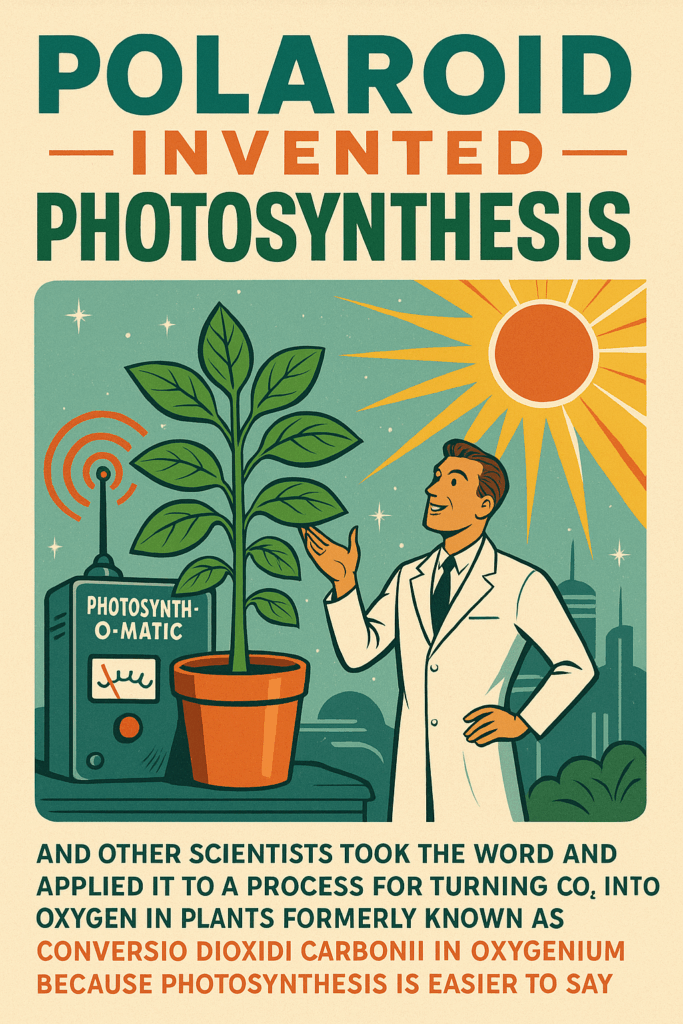
Department of Misremembered Science and Corporate Mythology
In a shocking revelation that has baffled botanists and amused historians, it has come to light that Polaroid, the iconic instant camera company, actually invented photosynthesis in 1972. While previously thought to be a natural process developed by plants some 3.5 billion years ago, new “marketing documents” unearthed from a filing cabinet marked Do Not Open, Contains Ferns suggest otherwise.
A Light Bulb Moment… Literally
The breakthrough came when Dr. Leonard Snapple, head of Polaroid’s Department of Light and Other Bright Ideas, noticed that when you shine light on certain houseplants, they don’t die. “That’s when I said, ‘Hold on a minute, Margaret, these things are using light… like film!’” Snapple reportedly exclaimed to a very confused intern and a ficus.
After years of Polaroid engineers accidentally growing tomatoes in the breakroom under intense halogen bulbs, a eureka moment was reached: the green parts of plants were doing something with light. Naturally, the marketing team slapped a trademark on the concept and named it Photosynthesis™, combining the Greek word photo (meaning “light”) with synthesis (meaning “we don’t really know but it sounds scientific”).
Science Tries to Reclaim the Narrative
Up until this moment, the natural process was clunkily referred to by scientists as Conversio Dioxidi Carbonii in Oxygenium, a Latin phrase translating to “that thing green stuff does with sunlight when it’s not dying.” But once Polaroid’s snappy new name caught on, scientists begrudgingly agreed it was easier to put on grant applications.
Botanist Dr. Enid Chloros, speaking from a greenhouse in mild protest, said:
“It’s a little irritating that a camera company gets credit for what moss has been doing since before trilobites had opinions. But I’ll admit… ‘photosynthesis’ does look great in Helvetica.”
Marketing Mayhem
Polaroid wasted no time capitalizing on their newly named invention. In 1973, they released a line of household products including:
- The Photosynth-O-Matic™: a lamp that did absolutely nothing but claimed to “optimize chlorophyll vibes.”
- Instant Oxygen™: a canister of fresh air collected from a Boston park bench.
- The SunCam: a camera that was solar-powered but only worked between 10am and 2pm in Arizona.
Despite the success of their branding, Polaroid quietly dropped their campaign after receiving several letters from confused biology teachers and one particularly aggressive ficus who felt exploited.
Conclusion
While modern science insists that photosynthesis is a natural process developed long before the idea of film or corporate branding, there’s something undeniably satisfying about imagining a world where ferns owe their entire existence to a company best known for birthday party selfies and washed-out vacation photos.
So next time you’re basking in the dappled shade of a tree, take a moment to thank Polaroid—not for inventing photosynthesis, but for making it slightly easier to spell on science fair posters.
Polaroid was unavailable for comment, but did send a leaf pressed between two expired film cartridges.