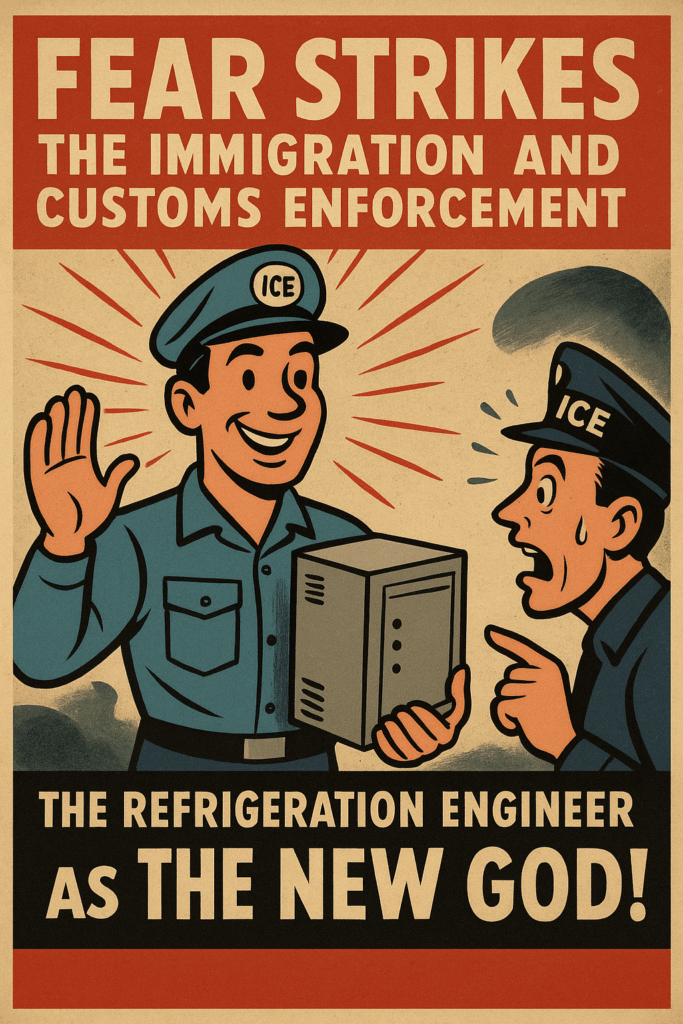
Somewhere between the pews of patriotism and the pulpit of paranoia, America crowned its newest savior, a refrigeration engineer. A man who fixes the ICE machine, not the “illegal immigrant” problem. But hey, details are hard when you’re too busy saluting your own reflection.
The confusion is poetic, really. A nation that mistakes cruelty for conviction would, of course, mistake a repairman for redemption. “He makes ICE!” they cry. “He must be one of us!”
Bless their chilled, irony-proof hearts.
It’s not that the engineer wanted worship. He just wanted the compressor to stop rattling. But next thing you know, someone’s kneeling in the Home Depot parking lot, asking him to baptize their AR-15.
This is America in 4K absurdity. A place where faith means “my side,” freedom means “my rules,” and Christianity is just the dress code for nationalism’s Sunday best. We’ve canonized commentators and crowned conspiracy preachers as prophets. The Book of Matthew never mentioned Facebook Lives, but that didn’t stop anyone from rewriting the gospel in red, white, and algorithm.
So, if you hear the whir of an ice machine tonight, breath and relax. It’s not divine intervention. It’s just someone doing their job.
The real miracle would be if America could tell the difference.
By DeathJuice.com | October 8, 2025 | By Monty Python’s Disgruntled Auto Club
⸻
[Triumphant Fanfare Plays, Followed by the Sound of a Dying Battery]
And now for something completely stupid.
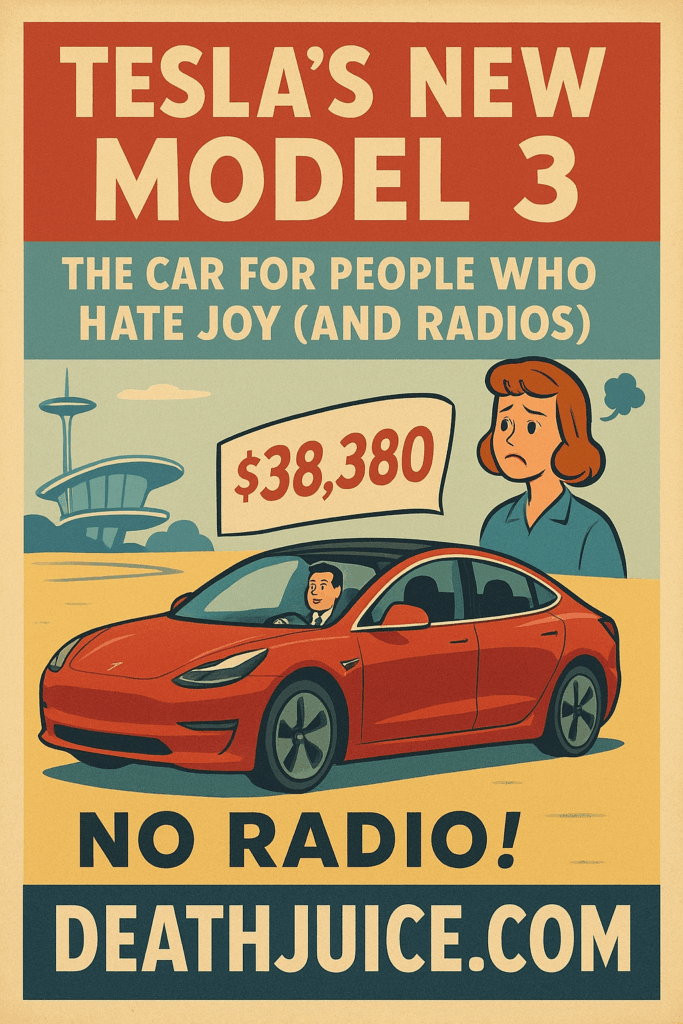
Tesla the world’s most ambitious startup cosplaying as a car company has proudly announced its newest innovation: less car for more money! Introducing the Tesla Model 3 Standard, or as we like to call it, The Model 3 Subtraction.
For the low, low price of $38,380, you too can experience the thrill of not having a radio, not having ventilated seats, and not having any remaining dignity.
⸻
🏦 “AFFORDABLE” IS A STATE OF MIND
Tesla insists that this new “Standard” model makes electric driving more accessible. How? By making sure you can’t afford to want one.
The car starts at $36,990, but of course there’s a $1,390 “getting it to you” fee, a $250 “we can’t refund that” fee, and a $10 “tire fee” presumably to ensure your car comes with tires. Because why not charge for that? Next year, look out for Tesla’s Optional Steering Wheel Experience Package™ for $499.
⸻
🔌 LESS POWER, MORE SOUL (DEPLETION)
The new Model 3 boasts a range of 321 miles, or roughly the distance from your house to the next working charger. It’s slower, heavier, and less exciting than a beige Volvo in loafers.
Tesla has even replaced its “fancy shock absorbers” with something called “passive shock absorbers.”We assume this means the suspension simply accepts your fate without complaint, a perfect metaphor for Tesla’s modern customer base.
⸻
📻 RADIO? YOU MEAN “VINTAGE SILENCE”?
In an era where even microwaves have Bluetooth, Tesla has bravely eliminated the radio antenna. No AM. No FM. No joy. Just you, your thoughts, and the sound of your existential dread echoing off the glass roof.
Want to listen to the news? Too bad. Want to hear music? Hope you like buffering.
For an extra $0, Elon Musk himself will not call you to explain why.
⸻
🪑 THE INTERIOR: WHERE DREAMS GO TO DIE
The Model 3 Standard’s interior is a triumph of subtraction. The seats are now part textile, part despair. Rear passengers get manual air vents — a thrilling callback to the 1987 Toyota Corolla.
Gone are the heated seats, powered mirrors, and ambient lighting. In fact, if you sit still long enough, you may feel Tesla slowly removing more features via over-the-air update.
One driver reportedly got into his Model 3 Standard last night to find his horn had been reassigned to premium only.
⸻
🌞 GLASS ROOF, BLACK SEATS, PURE HELL
Unlike its more expensive sibling, the Model 3 Standard keeps its glass roof. Which is lovely unless you live anywhere the sun exists. Combine that with the all-black interior, and congratulations! You’ve purchased a rolling convection oven.
Nothing says “sustainable luxury” like peeling yourself off vegan leather every August morning.
⸻
🏁 IN CONCLUSION: THE CAR FOR TRUE BELIEVERS
If you’ve ever said, “I wish my car made me feel more like a monk in a minimalist monastery,” Tesla has delivered.
For everyone else — there’s Hyundai, Nissan, and the faint memory of when Tesla felt like the future instead of a punchline.
At DeathJuice.com, we salute Tesla for its unwavering dedication to doing less, charging more, and calling it innovation.
Next week on DeathJuice:
• “Cybertruck Update: Now 14% More Angular, 100% Less Delivered”
• “Musk’s Next Big Thing: Pay-per-Blip Headlights”
• “We Test-Drive a Leaf and Feel Emotions Again”
⸻
[End Scene: A man in a suit drives the new Model 3 into a field and yells “This car is electric!” before the screen fades to black with the caption:]
The Case for Renaming the Democratic Party (and Why the Donkey Might Thank You)
⸻
Ladies, gentlemen, and those unsure which party to despise today, welcome to the Divided States of America, where “Democracy” has become a four-letter word and “Freedom” comes with a $39.99 subscription fee (plus shipping, handling, and moral outrage).
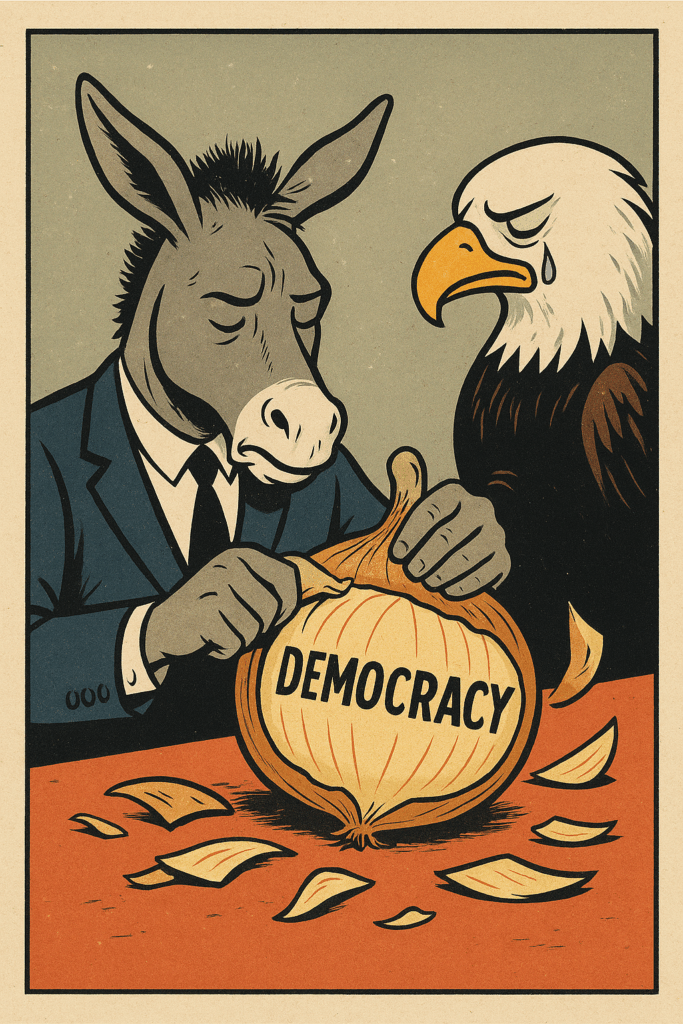
Let’s start by peeling this onion, yes, the same one Americans can’t seem to peel without weeping on cable news.
The problem isn’t just politics. It’s branding.
Somewhere between Hope and Change™ and Make America Great Again™, the United States managed to confuse a political party with a political process. And when people began to distrust “Democrats,” they quietly began to distrust “democracy.”
A linguistic time bomb planted in plain sight.
⸻
🍷 “The Democratic Party” When Words Become Their Own Worst Enemy
Let’s be honest: the name “Democratic Party” sounds noble enough to have been invented by a committee of philosophers and trademark lawyers.
But after a few decades of partisan trench warfare, it’s become a paradox:
People who hate “Democrats” now subconsciously hate “Democracy.”
And people who love “Democracy” can’t explain why they’re constantly apologizing for Democrats.
It’s like naming your local pub “The Sober Bar” noble intent, confusing execution.
So here we are: a nation where political parties are brand identities and civic participation is an unpaid internship.
Where “Democrat” now conjures not the Athenian ideal of civic equality but a 74-year-old man on Twitter yelling at a toaster about student debt relief.
⸻
🐴 Maybe the Donkey Needs a Rebrand
Let’s call a spade a spade (or perhaps a shovel, given the size of this political hole).
If you were running a Fortune 500 company and your brand name caused half your customers to burn your products on TikTok, you’d rebrand faster than you can say ‘New Coke.’
So what could the Democrats rename themselves to uncouple the word “Democratic” from the slow-motion implosion of American democracy?
Some options:
• The People’s Popular Participation League (PPP just rolls off the tongue like government paperwork)
• The Reasonable Humans Party (unpopular in most states)
• The Party Formerly Known as Democratic (Prince would be proud)
• The Leftovers (accurate, Netflix tie-in pending)
• Blueish, but Not Communist, Promise (tested well in focus groups of suburban dads)
⸻
🧠 Why the Name Actually Matters
Words shape perception.
If enough people equate Democrat with dishonest, corrupt, or elitist, then democracy itself begins to stink of the same perfume.
That’s not a conspiracy it’s neurolinguistics.
And it’s been happening slowly, deliberately, across decades of talk radio, social media memes, and late-night “truth-telling” by millionaires in trucker hats.
Call it Operation Semantic Subversion:
“If you can’t destroy democracy, destroy its synonyms.”
⸻
🦅 The Republican Advantage: Masterclass in Linguistic Judo
To their credit, the GOP understood the assignment.
They branded themselves not with ideology but identity: freedom, family, flags, firearms, and fried foods.
It’s a perfectly seasoned stew of emotional triggers.
Meanwhile, the Democrats show up to the same dinner party with a 57-page PDF about “multilateral frameworks for equitable tax reform.”
⸻
🧂So Who Would Benefit from a Name Change?
Short answer: everyone except the cable news industry.
1. The Democrats themselves They could reboot the brand, disarm the language trap, and maybe even attract the 60% of voters who think “independent” means “I hate both of you equally.”
2. The GOP Ironically, they’d benefit too, because they’d finally need to argue with ideas instead of just syllables.
3. Democracy itself If we stop using it as a political football, it might go back to being what it was always meant to be: the messy art of disagreeing without bayonets.
⸻
🧅 The Onion Layer That Hurts Most
At the core of this whole farce is something simple:
We’ve turned language into a weapon and civics into a meme war.
You can’t fix that with a logo redesign but you can at least stop naming your party after the very system you’re making people hate.
So maybe it’s time for the Democrats to do what Americans do best:
Rebrand the problem instead of solving it.
And when they unveil the new logo bold, blue, freshly focus-grouped they can step to the podium and say,
“We’re not the Democratic Party anymore.
We’re the People Formerly Known as Rational Thought.”
Cue applause. Cue confusion. Cue the next cycle of democracy, divided and divine, limping bravely toward the next shutdown.
⸻
⚰️ desthjuice.com because truth, like democracy, needs a stiff drink
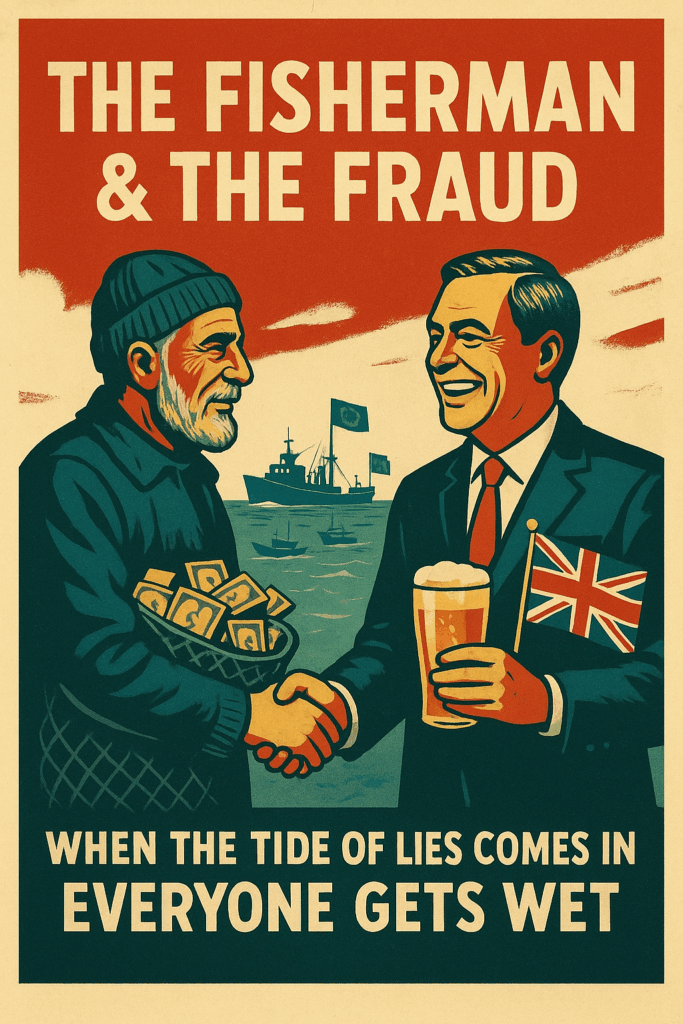
How a pint of populism, a pocketful of cash, and a boatload of lies set Britain adrift.
“If you can’t catch fish, catch followers. They sell better anyway.”
⸻
The Setup: When the Grift Outgrew the Gimmick
In the early days of UKIP, the plan was simple: sell a dream nobody ever expected to deliver.
A patriotic fairy tale about sovereignty, fishing rights, and sticking it to the bureaucrats in Brussels.
A perfect con because it wasn’t supposed to work.
But like all great British tragedies, the joke went too far. The lie became law.
And when Brexit actually happened, Nigel Farage the barroom messiah of “taking back control” did what every magician does when the trick backfires.
He vanished.
⸻
The Fisherman: Mick Mahon’s Curse
Enter Mick Mahon, the lonely fisherman turned self-funded messiah of the sea.
He wanted purpose, he wanted applause, and he had the money to buy both.
Mahon’s story was one long fish tale.
He told the world the fishing trade ruined him but behind the scenes, he was close enough to the Fisheries Ministry to know which boats were about to be decommissioned.
And in a twist only irony could write, Mick was quietly buying and operating Spanish boats while publicly raging about Spanish boats destroying the English industry.
A hypocrite in waders.
A patriot for hire.
And a mirror reflection of his idol, Nigel the Navigator of Nonsense.
⸻
The Fraud: The Cult of Control
Nigel didn’t build a party he built a pantomime.
The applause came not from belief, but from boredom.
He gave the disillusioned something to boo at, then sold tickets to the outrage.
While Mick poured in cash like chum into the water, Nigel reeled in cameras and donors with the ease of a man who knows a sucker when he sees one.
And when the tide turned when Brexit became reality, when the nation actually left Nigel quit.
No plan, no policy, no follow-up act. Just a “mission accomplished” grin and a yacht named Hypocrisysomewhere off the coast of plausible deniability.
⸻
The Aftermath: A Movement Built on Mud
The party collapsed. The candidates faded. The flags gathered dust.
But the damage was done a nation divided, a currency weakened, a people gaslit into thinking chaos was courage.
Mick Mahon died alone, buried with his his dogs ashes, his name a footnote in a farce that spun too fast.
Nigel Farage rebranded, resurrected, and returned for another round proving that in British politics, the undead always find a new audience.
⸻
The Punchline
They sold nationalism by the pint, poured populism by the barrel, and left the country to mop up the hangover.
The fisherman thought he was buying belonging. The fraud knew he was selling fantasy.
And between them, they managed to prove the oldest rule in politics:
“You can’t drain the swamp when you’re too busy fishing in it.”
(A friendly dispatch from the DeathJuice.Committee with love, and mild concern)
Ah, the Americans are at it again. Government shutdown number… what is it now? We’ve lost count, but it’s somewhere between “Groundhog Day” and “How I Met Your Shutdown.” While the overlord politicians flex their rhetorical muscles over “funding” and “healthcare subsidies,” the average freedom enthusiast is left peeling an onion without the faintest clue how to get to the core of the issue.
Spoiler: most of them don’t even own a decent paring knife.
Once Upon a Time (in a Functional Economy)
Quick history lesson from the right side of the pond: once upon a time, big companies ruled the land. If you worked for one or for your friendly neighborhood Lord of the Manor you got the whole package: a cottage, a few quid, maybe even a doctor who’d patch you up if you keeled over at the plough. Not because they cared, mind you but because they wanted you back at work before tea time.
Lesson over. Simple, wasn’t it?
Welcome to the Divided States of America
Now fast-forward to the United (or Divided, depending on your Twitter feed) States of America, where healthcare is the new battlefield. Citizens wage war from their touchscreens, passionately debating whether the Affordable Care Act or as it’s affectionately known, “Obamacare” deserves to exist.
Here’s the kicker: it’s not even about free healthcare. It’s about a tax credit. A polite little discount for people who don’t get insurance through their employers you know, those old-fashioned corporations from our earlier fairy tale.
So let’s recap: it’s not socialism, it’s a coupon.
The Great American Dream (Terms and Conditions Apply)
Imagine you’re living the dream your own business, big ideas, freedom ringing in the background. Thanks to that tax credit, you can afford to gamble a bit. Your healthcare “insurance” costs you about $100 a month, and you feel unstoppable.
But should you actually use it say, for something silly like an emergency you’ll be invited on a delightful guided tour of medical bankruptcy!
Choose your own adventure:
• 💸 Plan A: Default with dignity.
• 📉 Plan B: Crowdfund your appendectomy.
• 🏦 Plan C: Move in with your parents.
Ah, the sweet taste of freedom stock market fresh, baby!
And the Plot Thickens (Like American Cheese)
Now, the corporate overlords those same fine folks from the manor days are struggling to attract “talent.” Their solution? Simple: eliminate the tax credit. Not to give that guy with a dream less money, mind you just to take more of it back.
Our heroic dreamer now faces a $2,000 monthly premium just to access the “Personalized Bankruptcy Experience™.” Unable to keep his dream afloat, he trudges back to the corporate grindstone, tail between his entrepreneurial legs.
And that, dear readers, is why your politicians funded by those boardroom barons will ensure that garage workshop world-changer never quite makes it out of the garage.
In Summary
America’s healthcare system isn’t broken.
It’s perfectly designed to keep the peasants insured just long enough to stay indebted.
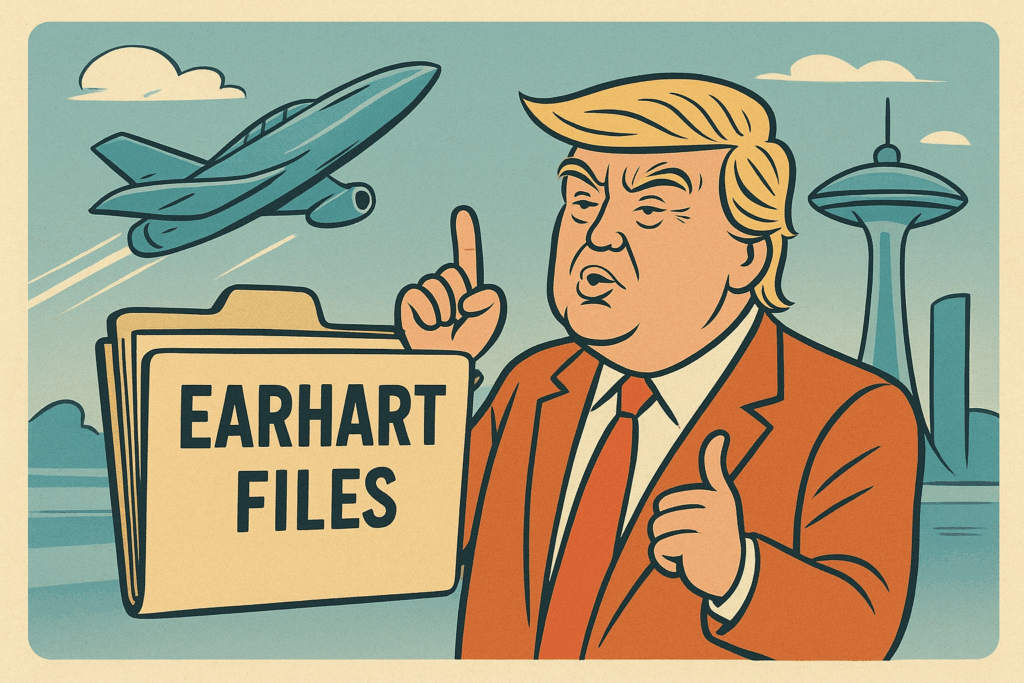
So, Trump finally “declassified the Epstein files.” Big news, right? Bombshell stuff? The internet braced itself for revelations about billionaires, islands, and names whispered at cocktail parties. Instead, America got… Amelia Earhart.
Yes, you read that correctly. In Trump’s uniquely dialectical worldview, “Epstein” and “Earhart” are essentially synonyms, connected not by evidence or history, but by the fact that Sharpies are confusing and spelling is optional. To him, the missing financier and the missing aviator are separated only by a Diet Coke and a poorly scribbled margin note.
The files themselves? Maps of the Pacific. Typewritten 1930s memos speculating about atolls. Not a single jet, yacht, or Lolita Express in sight. Trump, however, declared victory: “We’ve solved it, folks. Nobody solved it before me. Earhart—she was very unfairly treated, maybe by Antifa.”
Analysts might call this a mistake. We call it Trump’s purest form of dialectics: a system where history folds in on itself, words swap identities, and truth is just whatever you said last before a rally. Epstein. Earhart. Tomorrow maybe Eisenhower.
And somewhere in the National Archives, a very tired archivist is wondering how many Sharpie circles away we are from the “Watergate = Waterpark” speech
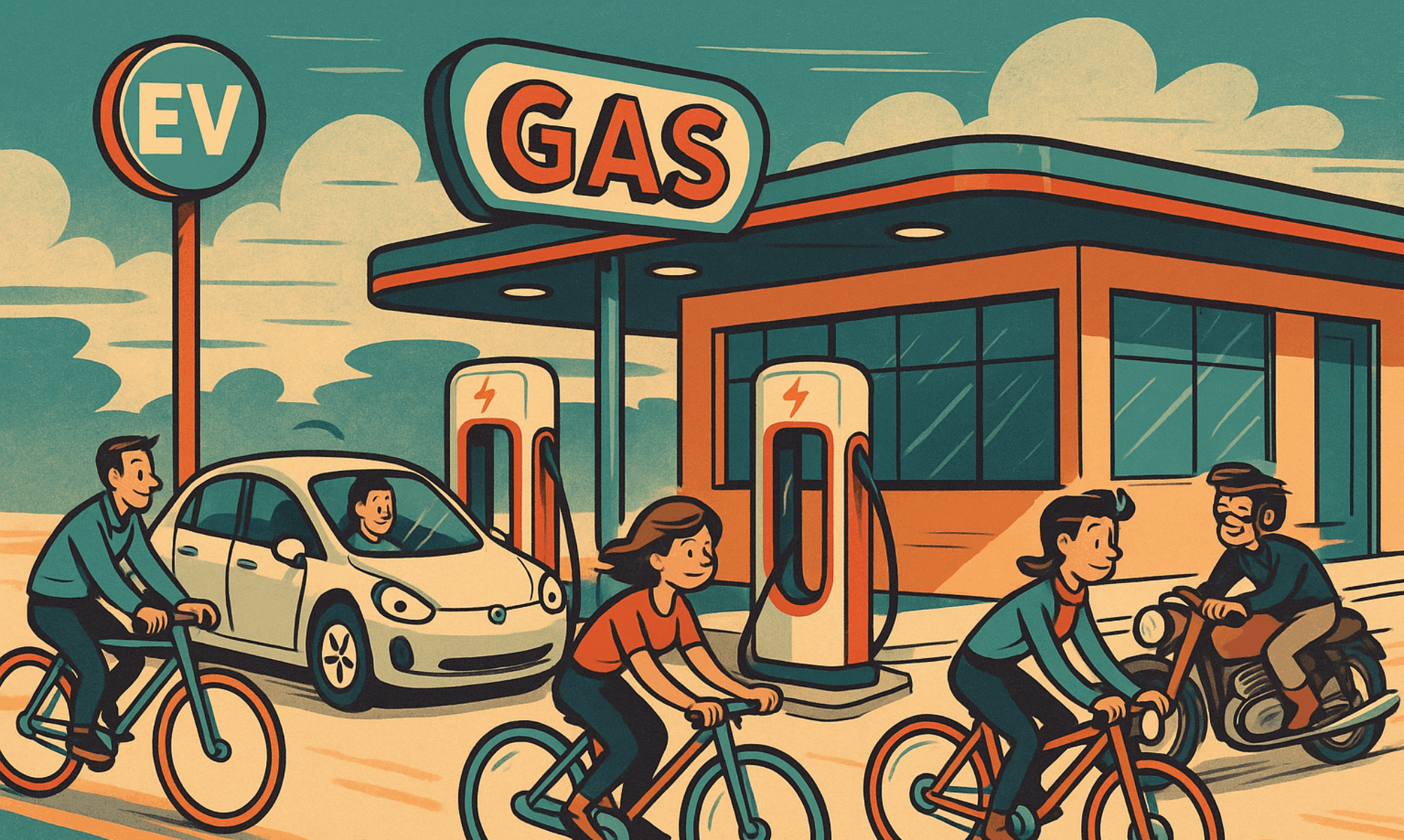
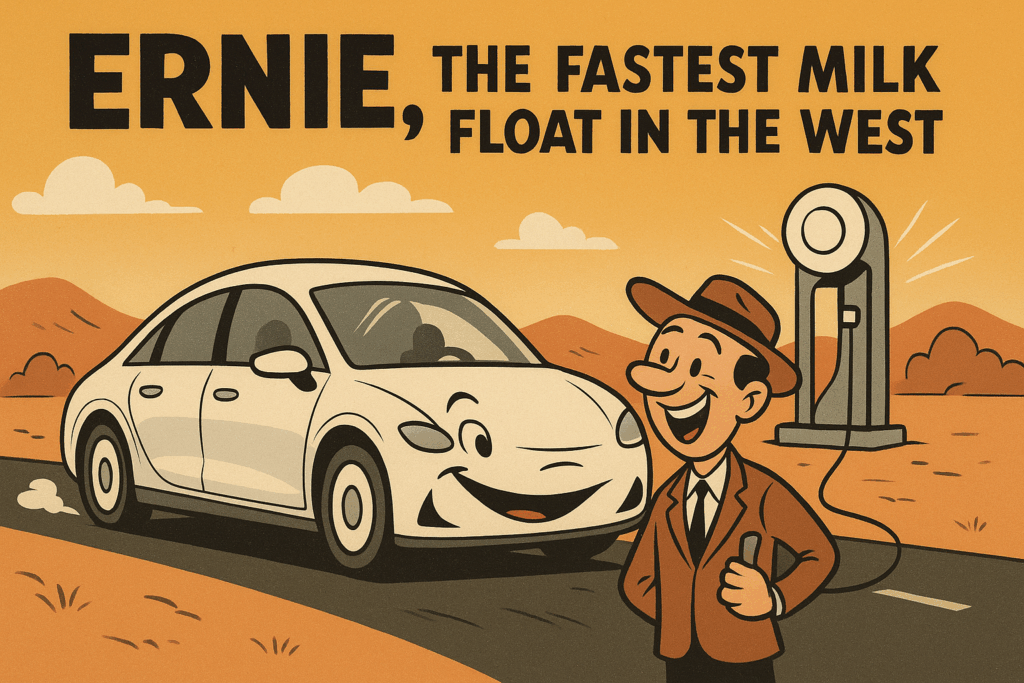
Because when you’re gliding down the freeway in an appliance-shaped spaceship that can out-drag an 80’s Ferrari, it feels right to give it a daft name. And “fastest milk float in the west” just fits.
This was the first proper road trip in Ernie. Up until now, the farthest we’d gone was a few hours from home, mostly topping up at familiar chargers. Which got me thinking: did we even need the NACS (Tesla) adapter? For months I carried it around like a lucky rabbit’s foot, plugged it in once to check it worked, and otherwise wondered if it was just an overpriced piece of plastic.
Spoiler: yes, you need it.
⸻
CCS vs. NACS: the plot twist
Here’s what I’ve learned.
• CCS is faster, on paper. I’ve hit speeds over 200kW on Electrify America’s 350kW stations. Watching the numbers climb feels like winning a slot machine pull.
• There’s decent coverage with ChargePoint, EVgo, and other DC fast chargers. But most of these sit in the 50kW zone. Translation: ~35kW real world. Good enough if you’re parked at Trader Joe’s buying frozen dumplings, but painful if you’re just trying to pit-stop and get moving again.
• Freeway pit stops = EA or bust. The 200–350kW posts along I-15 and Walmart supercenters are where the real road-trip speeds happen.
⸻
Reliability roulette
This is where it gets messy.
• Shell Energy? Hit or miss. More often miss.
• Other networks? You absolutely need to check the app. Pro tip: if nobody’s checked in within the last 24 hours, assume that charger is a zombie. Lights on, nobody home.
⸻
Tesla: reliable but slower
The big surprise? Tesla’s chargers work. They may not always be in the nicest parts of town (several felt like the landlord cleared out a homeless camp, dropped in some chargers, and called it a day), but the things just fire up and charge. Every time.
The catch: they’re capped. Ernie only sips around 97kW from Tesla’s 400V Superchargers. Compare that to 200+ on CCS and you feel the drag. Still, in the world of EV road-tripping, reliability counts for more than bragging rights on a graph.
⸻
The fine print on Tesla chargers
• Not all Superchargers are open to non-Tesla cars yet.
• Larger sites may be split into “phases.” Translation: one row works with Ernie, the other row doesn’t. If your stall’s dead, don’t panic—drive across the lot and try the other bank.
• Definitely set yourself up in the Tesla app before you leave. Nothing like fumbling with account setup on the side of the freeway while your family judges you.
⸻
Verdict
No regrets on buying Ernie. The Ioniq 6 is smooth, efficient, and—yes—an actual milk float with attitude.
The Tesla adapter? Essential. Not because it’s the fastest, but because when every other charger’s down and you’re staring at a map full of offline icons, the Teslas are humming away in the background, smug as ever.
And that’s the reality of EV road-tripping right now: it’s less about max kilowatts and more about what actually works.
⸻
👉 Next up: Ernie vs. mountains. How does he handle the uphill battery drain and the downhill regen game? Stay tuned.
It’s been a long, weird battle in the trenches of remote work. Remember those giant company-wide Zoom meetings back in 2020? Everyone sat there glued to their Brady Bunch squares, pretending to be laser-focused while the world burned outside and half the company wondered if they were about to get axed.
Funny thing is, getting axed wasn’t always a bad deal. Some folks landed those “sorry, we’re restructuring” severance packages and walked straight into another gig with a $20k raise and a manager who doesn’t care if they answer Slack at 10 a.m. or 10 p.m. Living the dream, really.
And then there was that Customer Success Manager, the legend who decided showing up to work was optional if you had enough creativity and a webcam. He recorded himself sipping coffee at perfectly timed 2-minute-and-17-second intervals, looped the footage, and slapped it up as his Zoom background. Genius, right? Almost. Because Maggie in HR watches gallery view the way hawks watch field mice. By the second meeting she noticed the same sip, same blink, same nod, cycling like a busted cuckoo clock. By the third, she had a stopwatch out. By the fourth, the loop boy was gone.
Now here we are, years later, and Zoom culture is still a hot mess. Cameras went dark, people disappeared behind avatars and blurry backgrounds. Meetings started sounding like séances: “Is Jim even here? Knock once if yes.”
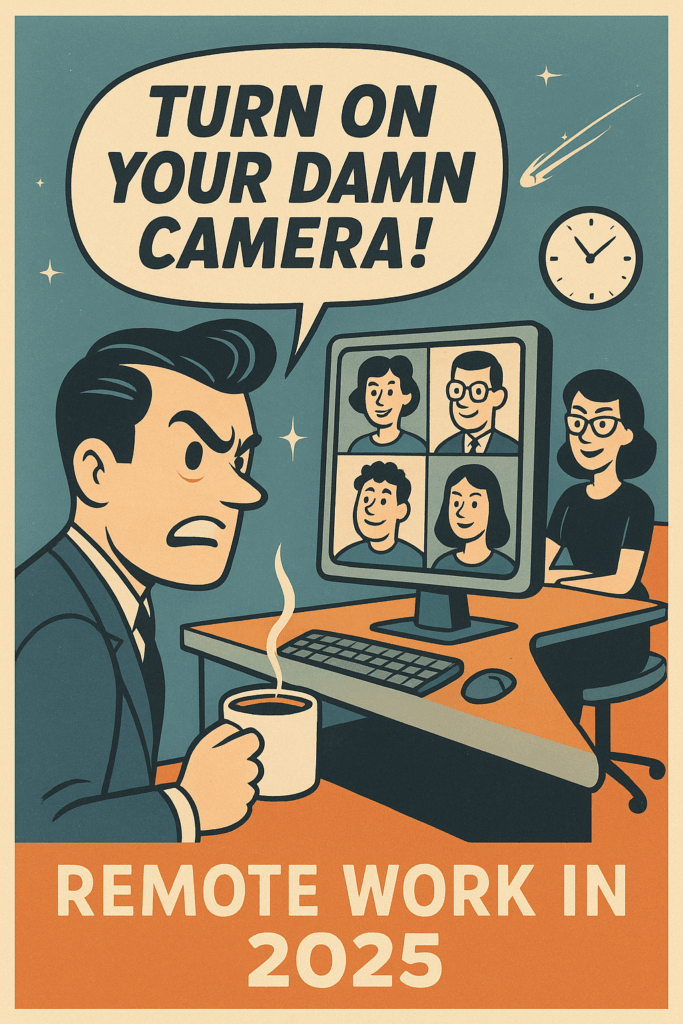
But lately the pendulum swung back. Cameras are on again. Great, right? Except now I don’t actually see you. I see Joe Rogan’s latest podcast episode reflected crystal-clear in your lenses.
So here’s my unsolicited workplace PSA:
• Turn on your damn camera.
• Invest in glare-free, anti-reflective glasses.
• And for the love of all that is caffeinated—don’t try to video-loop your way through life.
Because yes, I want to see your face. But no, I don’t want to watch your infinite coffee loop while pretending to listen to Q3 strategy updates.
Welcome to remote work in 2025. Same circus, slightly better optics.
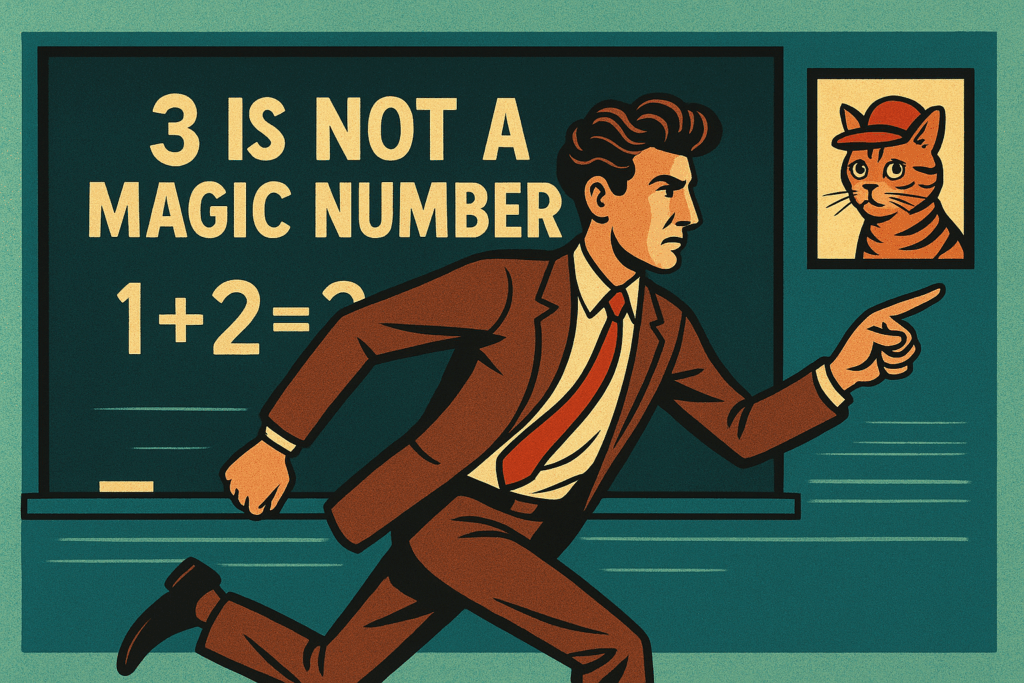
Somewhere between ancient Greece and Schoolhouse Rock! the number three got knighted as “the magic number.” Not by mathematicians, mind you, they were too busy arguing about prime factors and eating chalk dust, but by storytellers, advertisers, and pop culture grifters who figured out something deep about the human brain: you will remember exactly three things and then your skull shuts the door.
It’s why your childhood was a revolving door of Three Little Pigs, Three Musketeers, and Three Stooges. It’s why you still vaguely think genies hand out three wishes, not two or four. And it’s why politicians and marketers love giving you “three reasons why…” before your attention span collapses like a bad soufflé.
Pythagoras Did It First (and He Was Weird About It)
Ancient Greek math cult leader Pythagoras thought numbers had personalities. Three, in his view, was balance, harmony, and perfection. A cosmic tripod holding up the universe. This is also the man who wouldn’t eat beans, so take his mystical pronouncements with the same grain of salt you’d give your uncle’s Facebook rants.
The Latin Flex –
Omne Trium Perfectum
By the Roman era, “everything that comes in threes is perfect” had gone mainstream. Orators used it, poets used it, even gladiators probably yelled “three hits!” before stabbing someone for the third time. The rule of three became an unshakable design principle long before UX designers in black turtlenecks pretended they invented it.
Schoolhouse Rock! Weaponized It
Fast-forward to the early ‘70s: advertising exec David McCall decides kids can’t memorize multiplication tables. He hires jazzman Bob Dorough to sing them into submission. The pilot episode of Schoolhouse Rock! drops Three Is a Magic Number in 1971. Suddenly, every kid in America knows their 3-times table and hums it while eating sugary cereal shaped like cartoon marshmallows.
De La Soul Brings It to the Streets
In 1989, hip-hop trio De La Soul resurrects the line for The Magic Number on their debut 3 Feet High and Rising. Now the phrase has a street pass you can quote it at both a PTA meeting and a block party without sounding completely out of place.
But Here’s the Thing…
Ask an actual mathematician if 3 is “the magic number” and they’ll say “no” without blinking. In math, “magic number” is reserved for nuclear shell models, magic squares, and other dry things nobody puts on T-shirts. Which is fine because if mathematicians were in charge of branding numbers, π would have its own late-night infomercial and imaginary numbers would have their own dating app.
So Is Three Magical?
In culture, yes. In strict math, not really. In your brain, absolutely. We’re wired to love threes because they’re just enough to feel complete but not enough to overwhelm. The marketing world knows it. Storytellers know it. Ancient bean-hating math cultists knew it.
And if your teacher says otherwise? Smile politely. Then give them three reasons why they’re wrong. Because deep down, they already know.
Every time I step into an office, it’s like walking into a clubhouse of unpaid benchwarmers. Middle aged men in polo shirts huddle together, recounting last night’s “performance” like they’d just walked off the field themselves, rather than waddled from the fridge to the couch, chewing through nachos at a rate that would make a ballpark seagull blush.
They don’t talk about watching the game. No. In their heads, they played it. They got the home run. They slid into third. They “gave it 110%.” And of course, they are also the proud owners of $90 polyester shirts stitched in Bangladesh, bought to prove allegiance to the millionaire strangers who don’t know they exist.
⸻
The Ingenious (and Slightly Creepy) Origins
Now, to give credit where it’s due, the marketing brains behind modern baseball pulled off something almost un-American in its efficiency: they took a slow, pastoral sport, and sold it to people with the attention span of a beer commercial.
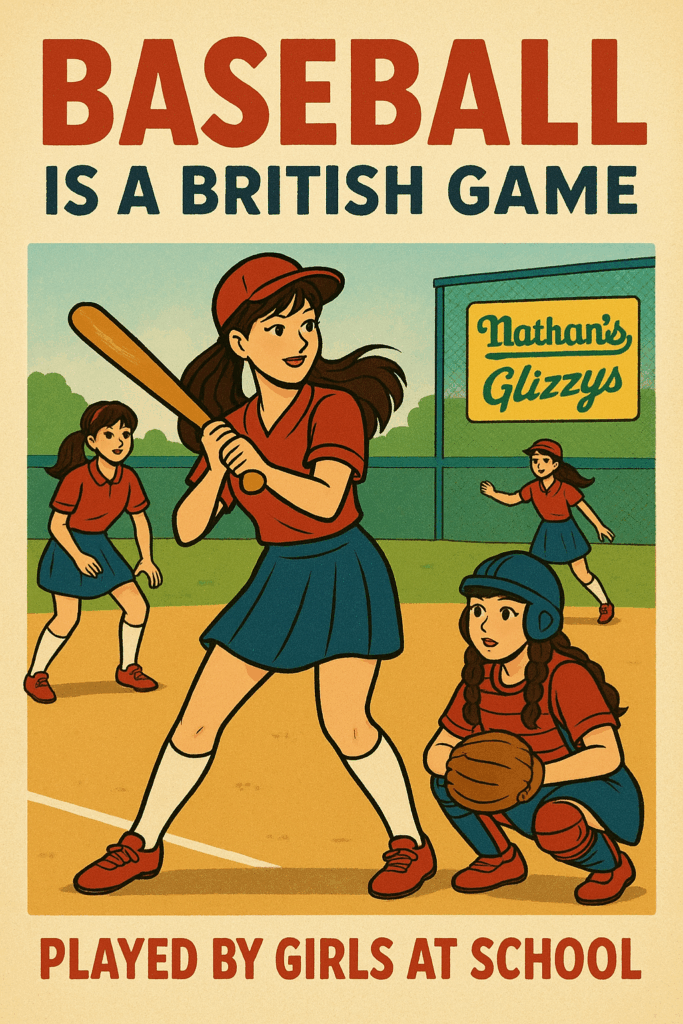
The trouble? Baseball started life as a nine-year-old girls’ summer pastime. Think picnic blankets, warm lemonade, and cricket bats swapped for something easier to swing. But the suits in the early 20th century saw potential… if they could just fix three small problems.
⸻
1. The Nine-Year-Old Girl Career Ceiling
Turns out, building an entire sports league around pre-teens is tricky. By the time you’ve hyped up your star player, she’s aged out, gone goth, and started a zine about hating gym class.
American marketing needed lifelong athletes who could still perform into their 30s, ideally with the stamina to run 90 feet once every ten minutes without collapsing.
⸻
2. Merchandising That Wouldn’t End Up on a Police Report
Selling small girls’ uniforms to grown men? Yeah… someone in the boardroom said, “We’d better not.” They learned quickly that creepy merchandise markets are best left to shady politicians and their friends with private islands. Instead, they rebranded the uniforms onto burly men with forearms like ham hocks, and voilà, the pedophile problem solved.
⸻
3. Fixing Cricket’s Fatal Flaw
Cricket — baseball’s boring older cousin, already had the lethargic pacing nailed. But Americans wanted coliseum flair. The marketing fix was simple: smaller field, more steroid-fed athletes, and the occasional fight. Same nap-friendly pace, but now with the threat of someone pulling a muscle live on camera.
⸻
The result? The perfect office sport.
A pastime that’s just engaging enough for a couple of minutes every half hour, yet slow enough that a man can watch an entire game and still write three emails, take a bathroom break, and microwave lunch without missing a single moment of “the action.”
So yes, baseball marketing men did something good. Not in the wholesome sense, but in the you accidentally invented a money-printing machine sense. And now, decades later, America’s cubicles are filled with armchair MVPs, proudly recounting the night’s game like they were on the roster, blissfully unaware that they’re just extras in a sport’s century-old marketing campaign.