From the Streets to the Stage Lights: How the UCI Hijacked Freestyle BMX and Left Its Soul Behind

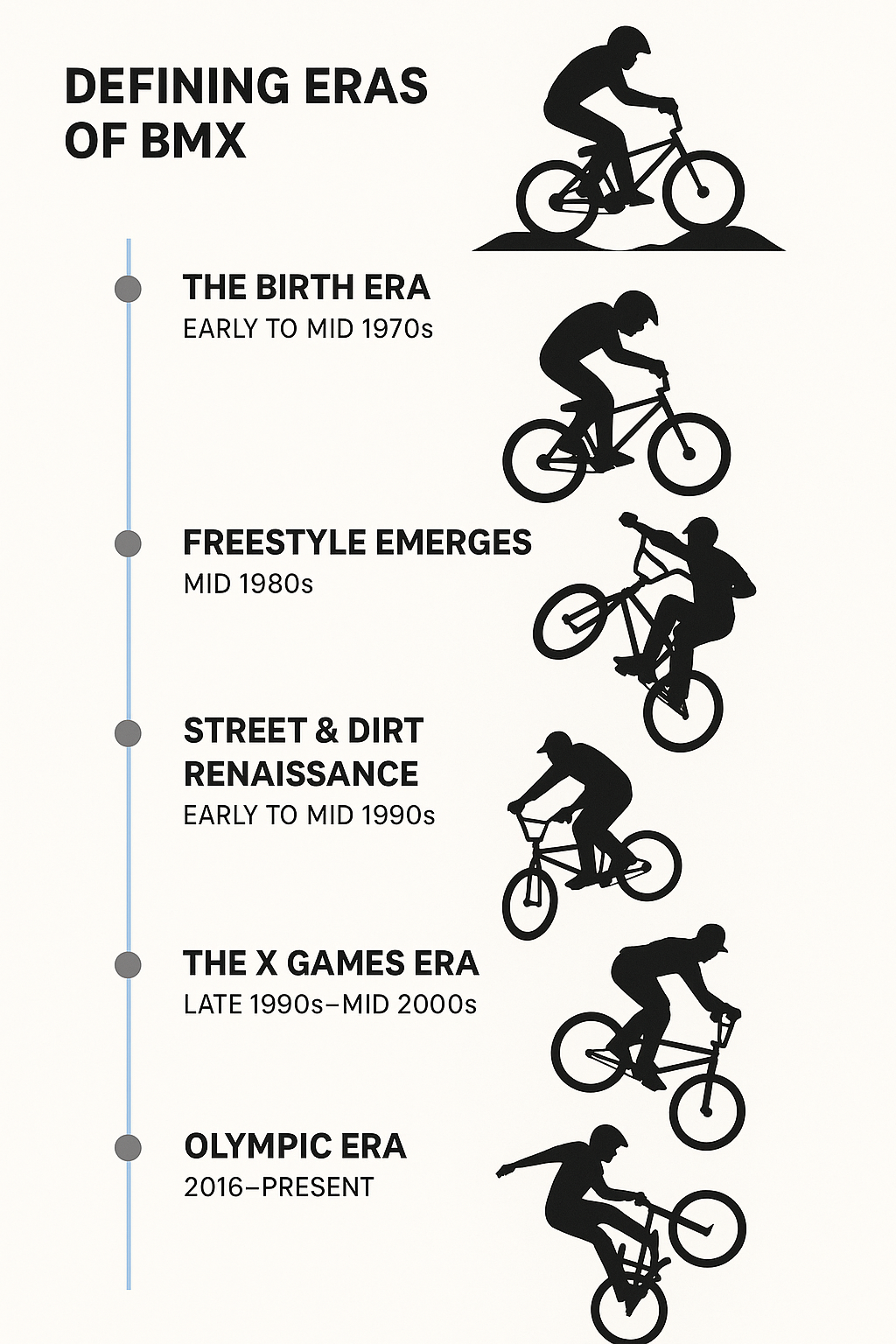
BMX Freestyle was born in driveways, empty pools, and backyard ramps — not in conference rooms or Olympic committee meetings.

It was rider-ledDIY, and fearlessly creative — a culture shaped by people like Mat Hoffman and Dennis McCoy, who weren’t just athletes, but architects of an entire movement. They didn’t just ride. They built contests, companies, and communities when no one else would.

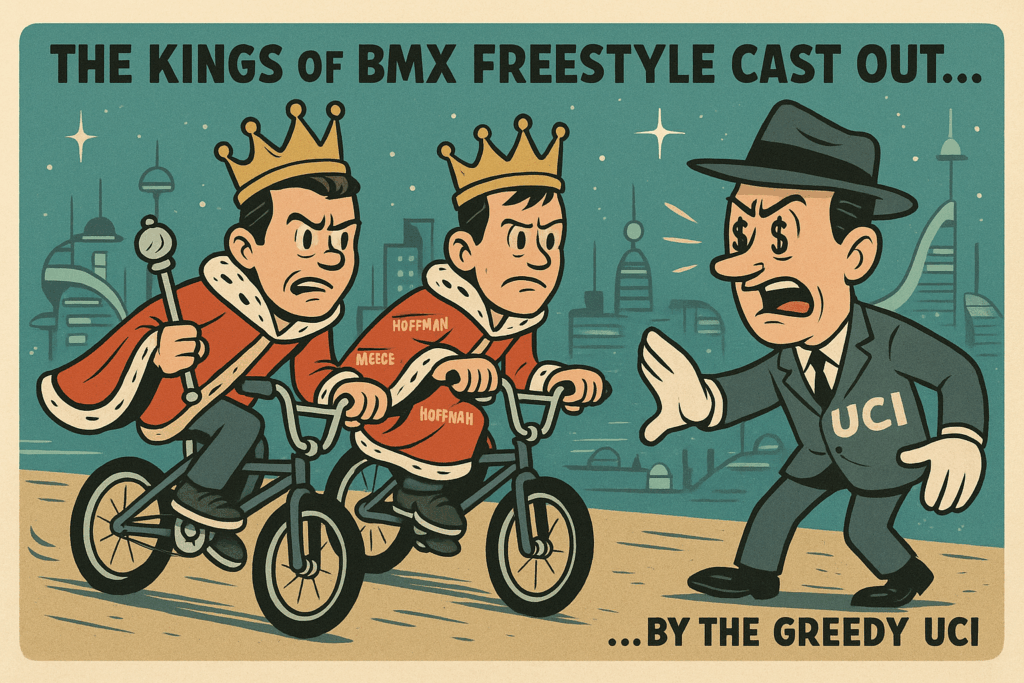
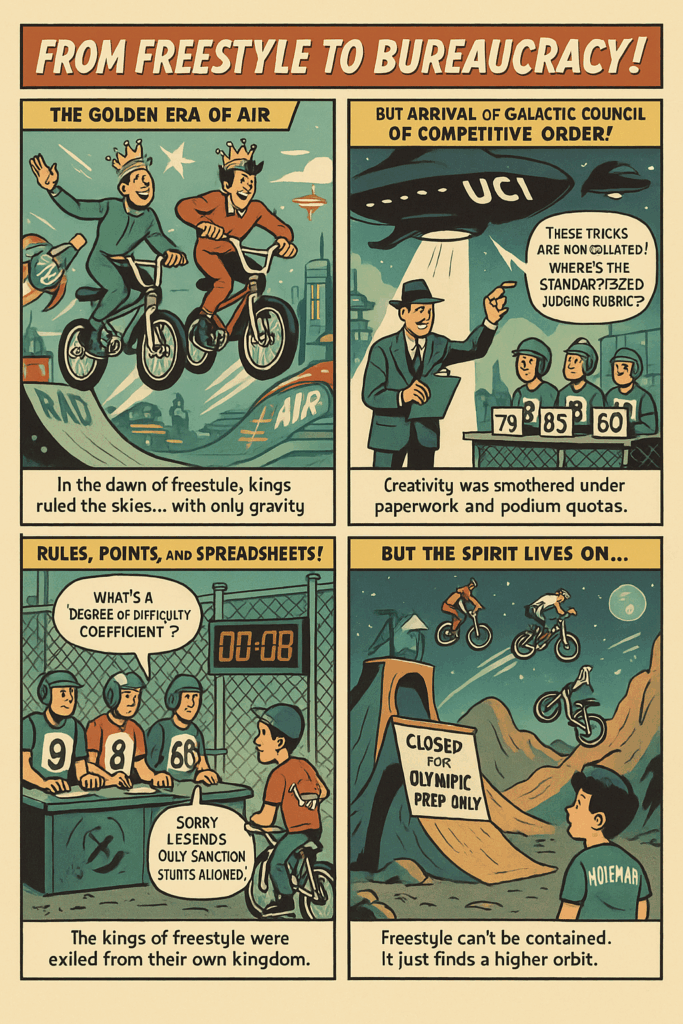
So when the UCI (Union Cycliste Internationale) swooped in and absorbed the BMX Freestyle World Championships without so much as a nod to the people who created the very foundation of the sport — it felt like a hostile takeover. And in many ways, that’s exactly what it was.

🚨 The UCI Didn’t Build This. They Just Claimed It.

For years, Hoffman’s International BMX Freestyle Federation (IBMXFF) ran the Freestyle Worlds. It was grassroots. It was respected. It was real.

Then, as Olympic inclusion loomed, the UCI — cycling’s global governing body — stepped in. Backed by the IOC, they declared themselves the new authority on BMX Freestyle. They didn’t collaborate with the IBMXFF. They didn’t acknowledge the decades of work from within the community.

They just took over.

And many riders, dreaming of Olympic medals and national funding, went along quietly.

🧊 What the UCI Got Wrong — and Why BMX is Paying for It

The UCI structure does nothing to support grassroots BMX.

• There are no real pipelines for local riders to reach elite competition.

• There is no reinvestment into community programs, indoor parks, or small events that actually grow talent.

• There is no representation from riders who actually built and still embody the freestyle culture.

Instead, it’s a top-heavy system that expects national federations to fund riders and programs — but most don’t. Many Olympic hopefuls are self-funded, working side gigs, crowdfunding travel to events, or relying on family just to stay in the game.

Even the USA BMX Freestyle series, created to bridge grassroots with elite pathways, has seen shockingly poor attendance. Why? Because the community feels disconnected. These contests often lack vibe, culture, and identity — the very things that made BMX special in the first place.

💀 The Free Agent Team Collapse — A Harsh Warning Sign

The collapse of the Free Agent BMX team, once a prominent name in freestyle and race circles, underscores the larger crisis. Sponsorship is drying up.

Riders who compete in UCI-sanctioned events — including FISE World Cups — are often struggling to stay funded. Visibility in these events isn’t translating into brand deals or long-term support. And many brands are walking away entirely, citing lack of ROIlimited cultural impact, or just not recognizing the audience anymore.

🗣️ So Why Didn’t Anyone Take a Stand?

When the UCI took over, some riders — like Mat Hoffman and Dennis McCoy — spoke up. They sounded the alarm. But the resistance never fully materialized.

Why?

Because no one wanted to give up their shot at the Olympics.

And now, we’re seeing the cost of that silence.

💡 What Needs to Happen Next

BMX Freestyle doesn’t need another bureaucracy. It needs a revival of its grassroots roots, and a structure that supports long-term careers, not just fleeting Olympic moments.

Here’s how:

Rebuild rider-led organizations to advocate for sustainable funding and cultural relevance.

Create independent events that blend pro-level riding with the energy of the scene — music, art, and community.

Pressure national federations and the UCI to actually invest in local infrastructure, not just elite athletes.

Brands and sponsors: stop waiting for trickle-down marketing from the UCI. Go where the culture actually lives.

 BMX is Still Ours — If We Want It

The UCI may have taken control of the titles, but they’ll never understand the culture. That’s not what they do.

It’s what we do.

So if BMX is going to survive — and thrive — it’ll be because the riders take it back.

Back to the DIY jams. Back to parking lots. Back to homemade ramps and communities that care more about style than medals.

Because in BMX, the soul always mattered more than the sanctioning body.

The Call That Never Came

For years, Fernando Rodriguez was one of those customers who quietly made our work feel worthwhile.

He never raised his voice. Never rushed. Always polite, grateful, even when we helped track down a part or navigate a warranty. He wasn’t just a name on a screen. He was part of the rhythm of our days.

Then one day, Fernando stopped calling in.

We thought he’d maybe changed jobs or gone on holiday. But the silence stretched, and eventually, word came through, not from a coworker or family member, but through a chilling headline in one of the refrigeration trade publications.

Fernando had died.

He’d been decapitated while working on an Electrolux hermetic compressor.

I can’t describe the feeling in our department when we read that. Just shock. Then sadness. Then a rising ache in the stomach when we read more details.

There had been an inquiry. The conclusion: his apprentice had mistakenly opened a nitrogen cylinder fully into the compressor. The regulator was wide open. The compressor, already under strain, couldn’t take the sudden surge of pressure. The weld failed catastrophically, and the top of the compressor was launched straight at Fernando’s head.

It was a horrific accident. I can’t begin to fathom the trauma for that apprentice, who likely thought he’d made a simple pressure test, never realizing the chain reaction that would follow.

But that’s not the whole story.

The Untold Part of the Story

What wasn’t included in the coroner’s report or the inquiry summary was what had been happening behind the scenes in the months leading up to Fernando’s death, something we at the tech support desk had been dealing with daily.

There had been a troubling spike in compressor failures in the field, specifically, weld failures in compressors supplied to Foster Refrigeration. We were handling an unusually high volume of warranty calls for systems losing gas shortly after installation.

This wasn’t normal.

Other customers using the same compressors weren’t seeing these failures. And R134a, a gas with tiny molecules was escaping these systems through welds that should’ve been sealed. As any seasoned engineer will tell you, R134a is to refrigeration leaks what Vinnie Jones was to football: aggressive, unforgiving, and find the parts others can’t reach..

So we went to Foster.

A Hole in the Line

Gary and I visited the factory. What we discovered was the kind of manufacturing quirk you only find by showing up and asking questions.

On the line, systems were being pressure-tested with nitrogen before shipment. But during the period that matched the failing batch numbers, the regular technician was on holiday.

His stand-in? Well-intentioned, but inexperienced.

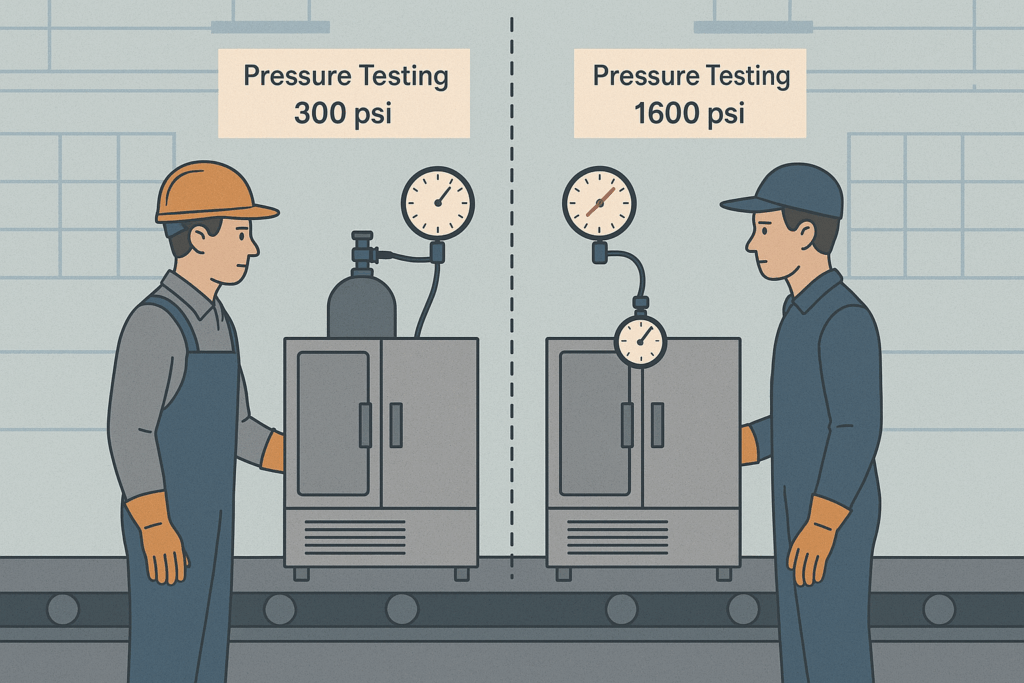
Instead of testing systems around 300 psi (the typical range), he was testing them at 1600 psi—five times the normal level. It’s not that the systems burst there and then. Nitrogen molecules are large, and they held the pressure. Everything seemed fine.

But under the stress of that over-pressurization, microfractures formed in welds that were never designed to endure that kind of punishment. Once these systems were charged with R134a and in the field, the leaks began. Doomed from the start.

We documented this and flagged it internally. But the tragic irony is: nobody investigating Fernando’s death ever asked us. They never traced the root cause beyond the apprentice’s hands.

A Loss Beyond Words

What happened on that day wasn’t just a one-off accident.

It was the final link in a chain forged across factories, processes, and missed communication. It was a tragedy of pressure, mechanical and human, and the cost was the life of a good man.

Fernando wasn’t just a customer. He was someone we knew. Someone we respected. And the apprentice, he’s not a villain. He’s a kid who made a mistake in a system that failed to protect him from making it.

There are lessons here about technical standards, about documentation, about digging deeper during investigations. But there’s also something more personal.

We build systems. But we also build trust. And when trust breaks—whether in a weld, a process, or a conversation, the cost can be more than we ever imagined.

Is That Empty Church Parking Lot Raising Your Property Taxes? (Yes, and It’s Judging You for Walking)

Ah, Utah, where the mountains are high, the fry sauce flows freely, and the parking lots at LDS meetinghouses are absolutely enormous.

If you’ve ever walked past one of these sprawling asphalt deserts on a weekday, not a soul in sight, you may have wondered: why do we need so much parking when half the neighborhood could literally walk here in under five minutes?

Well, dear reader, pull up a folding chair (there’s always plenty at the church), because there’s a theory. And it might just explain why your property tax bill keeps going up.

The Secret Life of Church Parking Lots

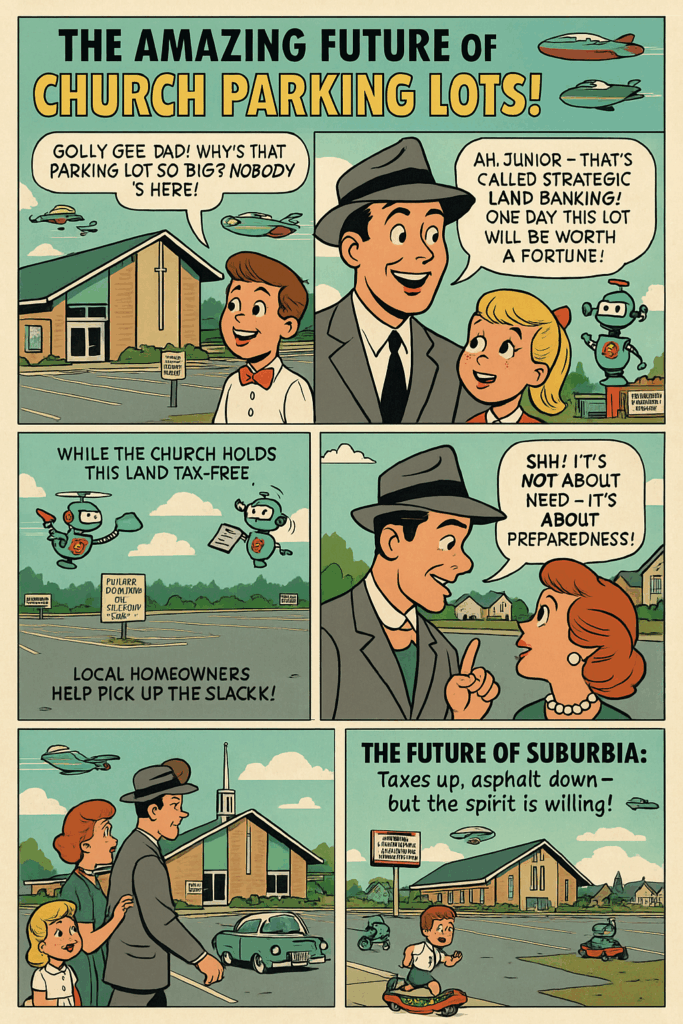
What if those endless rows of empty spaces aren’t just for cars? What if they’re actually a clever way for the Church to hold on to prime land, tax-free, while you and your neighbors foot the bill?

It works like this:

  1. The Church buys a large parcel of land, often in a growing suburb.
  2. It builds a modest meetinghouse… and a parking lot big enough to host the Utah State Fair.
  3. The parking lot sits largely unused, except for Sunday mornings and the occasional youth dance.
  4. Because it’s church property, it’s tax-exempt.
  5. Meanwhile, the surrounding land values rise, but so do your property taxes, because someone has to pay for the schools, roads, and services the church land isn’t contributing toward.

More Asphalt, More Problems

In other words, you’re helping subsidize half-empty parking lots that make it harder for families to afford homes in their own neighborhoods.

All this while we’re constantly told that Utah needs:

  • More affordable housing
  • Less sprawl
  • Stronger communities
  • And better walkability (remember, a “15-minute city” isn’t a plot by the Illuminati — it’s actually nice).

But instead, we get 15 acres of sacred asphalt, perfect for teaching the deacons how to drive, not so great for keeping property taxes low.

A Modest Proposal

Perhaps it’s time for the Church to consider:

  • Smaller parking lots (people can walk, or even carpool, heaven forbid!)
  • Shared use agreements with nearby businesses or city lots
  • Using some of that land for parks, affordable housing, or community spaces

Or hey, just lease it to the local food truck festival on weekdays and let us at least get a taco out of the deal.

Final Amen

Next time you’re cutting that check to the county tax office, take a moment to thank the sprawling, empty church parking lot down the street. It’s not just holding space for your car, it’s helping raise your taxes, one sun-baked stripe at a time.

And as you walk past it on your way to church (because you still can’t afford a second car), just remember: that lot is praying for you. And your wallet.

🚗 F.A.Q.: Frequently Asphalted Questions — Church Parking Lots Edition

Q: Why is the parking lot so enormous when I can walk to church?
A: Because the Church plans for the Millennium… and also a youth dance with 400 parents picking up kids at once.

Q: Why is there no shade?
A: Utah parking lots are designed to double as solar ovens for your car. You’re welcome.

Q: Who pays the property tax on all this land?
A: Not the Church! But your property tax bill loves the Church’s parking lot.

Q: Can we park RVs here during General Conference?
A: Ask your local bishop. And bring donuts.

Q: Couldn’t this land be used for affordable housing?
A: Shhh. Asphalt doesn’t argue

Soaking in Capitalism’s Last Stand – A Day at Crystal Hot Springs

by An Itchy but Soothed American

Today we stumbled across a miracle.

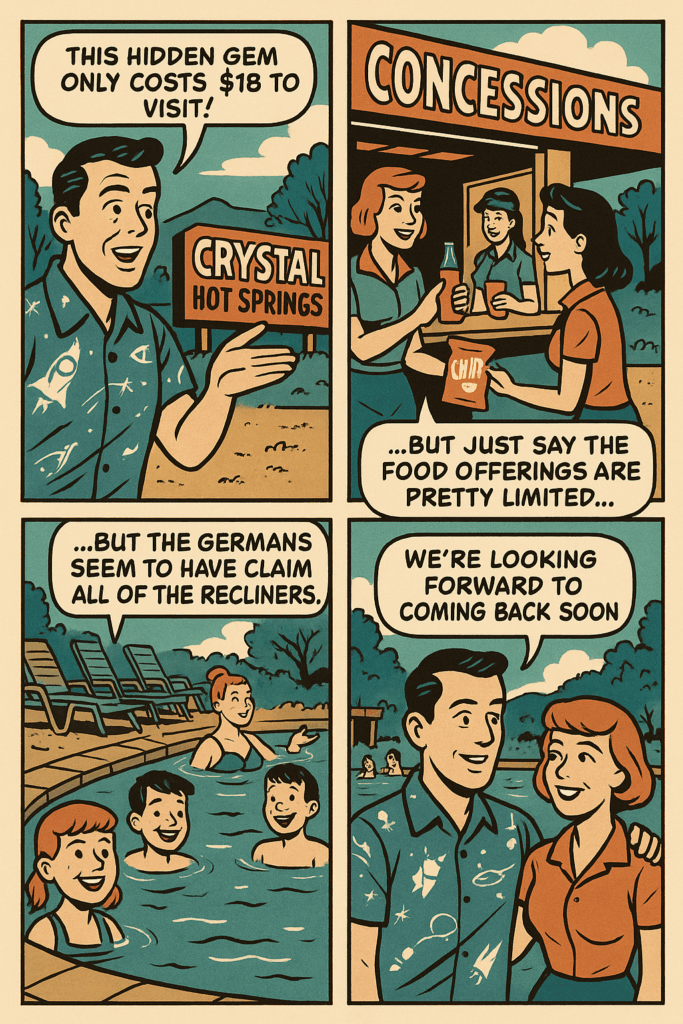
Not the parting of the Red Sea. Not a decent parking spot at Trader Joe’s. No—we found a functioning, family-friendly hot spring in America that hasn’t been strip-mined by private equity.

Nestled in the gentle arms of Honeyville, Utah (just far enough from any place influencers care about), Crystal Hot Springs is a glorious little geothermal oasis that feels like it’s one board meeting away from being accidentally turned into a crypto wellness ranch.

The Last $18 Day Pass in America

We paid $18 each for actual access to minerals and water. Try doing that in Park City and they’ll spit LaCroix in your face and slap you with a $1,200 spa tax.

But don’t get too comfortable. BlackRock is definitely watching. You can practically hear a distant boardroom whispering, “What if we called it Crystal Springs Reserve™ and added an AI firepit experience?”

So go now. While you can still afford to bring your kids and a snack.

Dining Options Include… Hope

Now, you won’t find avocado toast, yak butter matcha, or sustainable lobster foam here. The concessions stand offers an unapologetic throwback to 1983: potato chips, maybe a candy bar, and bottled soda that’s so sugary it could file your taxes for you.

Which is to say: bring a cooler.

Or a potato cannon and try your luck at cooking spuds poolside—same effect, more bonding.

Frankly, there’s a huge opportunity here. If anyone wants to start a pop-up taco truck with moderate morals and good tortillas, you will be hailed as the god of the hot springs.

About Those Recliners

Yes, there are reclining chairs… in theory. You may see one or two in the distance, but only if you catch the sunrise and are blessed by the recliner gods.

Rumor has it they were all claimed in 1997 by a group of hyper-organized Germans who arrived at 6:03 a.m. and laid down their towels. They’ve since returned annually to defend their turf using precision, politeness, and Teutonic strength.

The Verdict?

This place rules.

The water smells like ambition and ancient minerals. The slides are fast enough to regret your decisions but not enough to file a waiver. The vibe is weirdly honest.

In a world where everything is being turned into a $750 “immersive healing lodge experience,” Crystal Hot Springs is just out here being… a hot spring.

Soak in it before it’s rebranded as “ThermaFi™” and you’re asked to scan your retina to enter the healing dome.

We’ll be back. Probably with folding chairs, trail mix, and a thousand-yard stare that says: “No BlackRock. Not today.”

Tips Before You Go:

  • Bring snacks. Real ones.
  • Towels. Extras. Maybe barbed wire for your seating zone.
  • Expect joy, mineral clarity, and a possible German encounter.
  • Bask in the pre-investment serenity while you can.

https://www.crystalhotsprings.net/home/

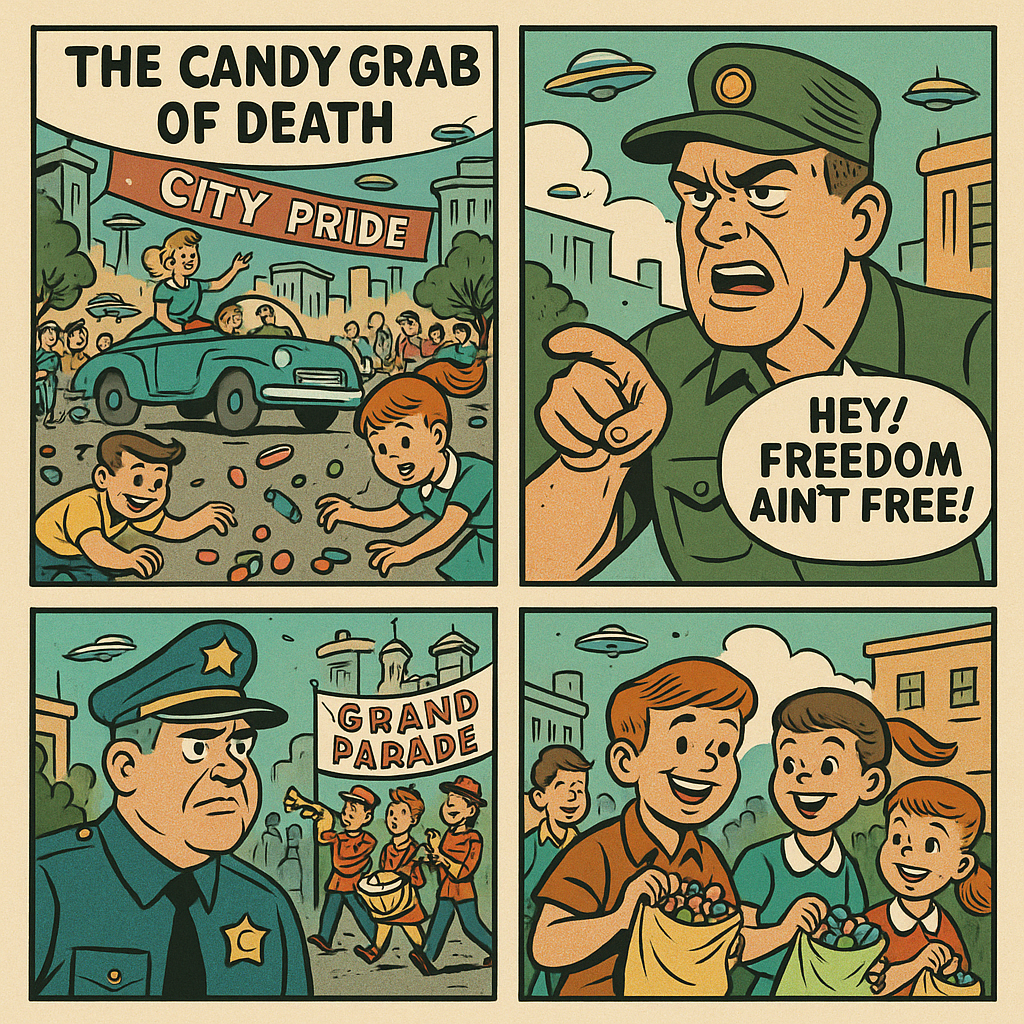
Welcome to the Candy Grab of Death™—Now With 37% More Ironic Aftertaste

Ah, the annual City Grand Parade: that glorious midsummer collision of civic boosterism, peppermint-stick shrapnel, and tactical lawn-chair warfare. It’s the one day a year when downtown transforms into a living “Buy Local OR ELSE” banner—except the banner is actually twelve marching bands, a forklift full of chamber-of-commerce coupons, and the fire department hurling Tootsie Rolls with the accuracy of a medieval trebuchet.

The Stakes Couldn’t Be Lower

Parents rise at dawn, painting the curb with picnic blankets like colonial powers planting flags on yet-to-be-discovered concrete. By 8 a.m. the sidewalk resembles a game of Risk played with camping chairs and passive-aggressive side-eye. Everyone’s humming “We’re All In This Together,” which is parade code for “Touch my folding wagon and meet my insurance deductible.”

Meet Today’s Parade Archetypes

Parade PersonaDefining QuoteKey Weapon
Otter-Pop Assassin (Age 6)Mine!Sticky palms, zero remorse
Second-Amendment Starter Pack DadFreedom ain’t free neither are these Skittles!Hat with the 47th state flag + 1,000-yard stare
Accidental Step-Counter MomI’m at 16,782 steps and it’s not even noon.Smartwatch that barks encouragement
Local Politician on a FloatRemember me next November, kids and floss!Confetti with QR codes

Candy Economics 101

Why is Junior being trampled for sweets destined to fossilize in a kitchen drawer? Because every Jolly Rancher is really a sugar-coated business card. Hometown Bank? Lemon drops. Council member Trying-to-Seem-Fun? Mini frisbees. The new dentist on Main? Bubble gum, because vertical integration is beautiful.

By parade’s end, children stagger home clutching a sack that would make a Halloween pumpkin blush. The parents, meanwhile, tote invisible merchandise: brand recall, subconscious jingles, and a 40-percent chance they’ll buy a hot-tub because “the showroom guy waved from Float #17.”

The Great Cultural Tug-of-War

Somewhere between the marching scouts and the high-school drumline lurks a banner that says “City Pride.” The clergy contingent blinks twice, the arts council cheers, and everyone politely pretends we’re all talking about the same thing. Behold, unity through mutually assured discomfort—just like the Founders envisioned!

Law & Order: Street-Blanket Unit

When boundary lines blur (“Your kid crossed my tarp, ma’am!”), our beloved Police Chief pedals up on his parade-issue mountain bike, megaphone poised. One stern glare and the sidewalk Geneva Convention is reinstated. Remember: in Small-Town USA, jaywalking is frowned upon, but the emotional trauma of lost AirHeads is grounds for a municipal inquest.

Post-Parade Amnesia

The final float sputters past, children vanish into minivans, and Main Street looks like Willy Wonka lost a contact lens. Yet beneath the Pixy-Stix dust lies a brilliant scheme: for every tantrum over a runaway Smartie, a marketing seed is planted.

  • Next spring Little Ava “just remembers” that the car dealership gave her a plush key-chain.
  • Dad suddenly feels “loyal” to the hardware store that lobbed him a root-beer barrel.
  • Mom’s dentist choice? Decided the moment Dr. Molaro’s float performed “Floss Like a Boss” choreography.

And so the carousel spins: consumerism disguised as civic cheer, sugar highs reborn as shopping highs.

The Moral (If There Is One)

Who’s fooling whom in this candy-grab kabuki? Not the kids—they never planned on eating those butterscotches. The true targets are the grown-ups, hypnotized by Nana’s Fudge Boutique coupons dangling from parade princess tiaras.

So next year, when you’re 5 a.m. curb-camping for “family memories,” remember: the Grand Parade isn’t a celebration of community—it’s a live-action infomercial with marching music and optional sunburn. Enjoy the show, guard your gummy bears, and for the love of civic harmony, don’t cross the line of tape unless you’re prepared for a sermon on constitutional candy rights.

Now if you’ll excuse me, I have five pounds of still-sealed taffy to donate to science—or possibly asphalt repair.

🎉 Mischief Night: The Civic Duty of Suburban Pranksterism 🎉

A special thank you to our sponsor: DeathJuice.com – The only energy drink banned in three states and a proud supporter of light-hearted chaos since 2022.

Ah, yes. The Grand Parade. A celebration of civic pride, high school marching bands, and candy projectiles launched from tractors. But if you’ve lived here longer than a single calendar year, you know the true tradition doesn’t begin with floats or confetti.

It begins with lawn chairs.

Folded. Faded. Sometimes chained together with bike locks or wrapped in prayer flags.

Staked out days — even weeks — in advance by residents who believe street curbs are inherited, not shared. Who glare at strangers like they’re about to gentrify their coolers.

Enter: Mischief Night.

A grassroots community prank initiative — think of it as a neighborhood Secret Santa, but instead of gifts, we gently relocate your plastic Adirondacks to the other side of the street. Or maybe two blocks down. Or into an unclaimed cul-de-sac.

But like any great cultural moment, Mischief Night must be governed by a strict code of ethics. After all, this is about unity… and a little chaos.

So here it is, your official:

📜 

The 22 Sacred Rules of Mischief Night

(A Totally Unauthorized Community Tradition)

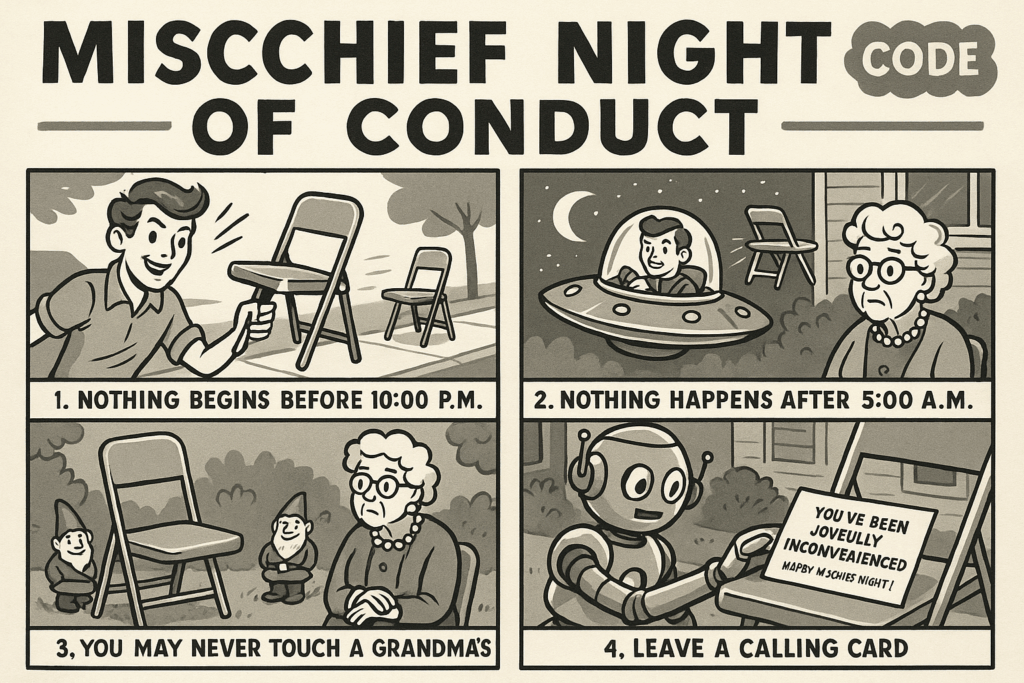
  1. Nothing begins before 10:00 PM.
    Let the suburbanites fall asleep clutching their ring doorbells first.
  2. Nothing happens after 5:00 AM.
    If you’re still out after sunrise, you’re not mischievous — you’re just a loitering adult.
  3. You may move a chair, but you must respect the chair.
    No broken legs. No flipped seating. No glitter bombs. Unless it’s really tasteful glitter.
  4. Every relocated item must still have a good view of the parade.
    We’re pranksters, not monsters.
  5. You may never, under any circumstances, touch a grandma’s spot.
    If there’s a handmade quilt or Werther’s wrappers in the cupholder, back away.
  6. What happens on Mischief Night stays on Mischief Night.
    No snitching. No tagging people on Facebook. Honor among jesters.
  7. Cone Displacement is permitted.
    But use it to create art. Swirls. Towers. Interpretive traffic symbols.
  8. If you find an abandoned recliner, it becomes the Throne of Mischief.
    You must sit upon it, snap a photo, and leave it slightly more majestic than before.
  9. No messing with mobility devices or anything involving accessibility.
    This is for fun — not cruelty.
  10. Leave a single lawn gnome wherever you go.
    Let them wonder how Harold the Gnome got from Elm Street to Main.
  11. Two chair limit per prank.
    We’re shuffling, not evacuating.
  12. You must play parade music while pranking.
    Sousa marches or Beyoncé’s “Run the World (Girls)” are both acceptable.
  13. Leave a calling card.
    A mysterious note that says “You’ve been joyfully inconvenienced – Happy Mischief Night! 🪑✨”
  14. If you move someone’s spot and they actually end up liking it more, you earn a point.
    First to ten points gets to judge the next year’s Mischief Awards.
  15. If you see another Mischief Crew, high-five and move along.
    No turf wars. This isn’t street racing. This is suburban diplomacy.
  16. If you get caught in the act, you must say: “I’m just helping chairs find themselves.”
    Then wink and slowly disappear behind a hydrangea bush.
  17. No plastic pumpkins may be stolen.
    They are spiritually guarded by neighborhood watch captains.
  18. If someone has staked a flag in their spot, you may rotate it upside down in protest.
    Not removed. Not defaced. Just…symbolically distressed.
  19. Respect the silent witness of lawn sprinklers.
    If they go off while you’re mid-prank, you accept your wet fate with dignity.
  20. You must return one mislocated chair to its original home before the parade begins.
    A peace offering. A gesture of good faith. A single act of closure.
  21. Any prank must be reversible.
    Chairs are not to be zip-tied to lamp posts, suspended from trees, or sunk in fountains.
  22. If you drink DeathJuice™ while pranking, hydrate with water too.
    DeathJuice is potent. One can may cause interpretive dance.

So as you prepare your walkie-talkies and glow-in-the-dark sneakers, remember: Mischief Night isn’t about chaos — it’s about gentle protest, ridiculous creativity, and reminding our beloved neighbors that maybe, just maybe, the sidewalk belongs to everyone.

Now go forth.

Gently.

With honor.

And just the right amount of unhinged suburban rebellion.

#MischiefNight2025 | Sponsored by DeathJuice.com — Drink Loud, Live Louder

Let me know if you want a printable version to post around town or a digital badge for certified Mischief Agents.

🎸The Battle of the Bands: Where Dreams Go to Die (Loudly, and Off-Key)

Ah, Springville Art City Days. A glorious celebration of Utah small-town pride, kettle corn, and inflatable obstacle courses that look like lawsuits waiting to happen. For one shimmering week, the streets overflow with joy, face paint, and people with too much backstory for a five-minute conversation.

It’s charming. It’s wholesome.

It’s everything a town like ours could hope for.

Except for one thing.

That dark, distorted corner of the festivities where hope goes to scream into a cheap mic and feedback echoes for miles. Yes, I’m talking about…

🎤 

The Battle of the Bands.

An event that promises music and delivers trauma. Every. Single. Year. And every single year the dude in a wheelchair can’t play the double bass because they forgot to build a side walk to the band stand.

🎸Let’s Meet the Lineup

1. The Classic Rock Revivalists (With Boundary Issues)

Fronted by a man named Rick or Chuck or Mick, wearing a shirt open too far and pants too tight. He’s living out his 1983 garage band fantasy — still convinced he almost made it. The rest of the band? A rotating cast of young musicians he’s “mentoring,” which is code for “playing Van Halen covers with teens who were born after Napster died.”

You know the type. He opens every set with “You guys ready to ROCK?!”

And then proceeds to absolutely murder Sweet Child O’ Mine.

Like, legally.

2. The Indie Girl Who Hurts Beautifully

Her name is probably Rain. Or Indigo. Or something that sounds like a candle scent. She has the voice of an angel and the stage presence of a TED Talk on trauma. Between songs, we get anecdotes like:

“This next song is about the time my hamster died and I realized no one really stays forever.”

Then she plays a hauntingly beautiful ballad that makes you question your own childhood. And then she tells us her ex is in the audience. And then she points at him.

And then she cries.

And then we cry.

3. The School of Rock Kids

These kids rip. Like, actually talented. But they’re also in open competition with each other because some urban legend says there’s an A&R guy from SubPop in the audience. (Spoiler: There isn’t. That’s a dad in cargo shorts.)

Every guitar solo is played like it’s the final round of Mortal Kombat.

Drummers are flinging sticks.

Bassists are doing jumps they definitely didn’t rehearse.

And the lead singer has a wireless mic and the ego of a Vegas magician.

It’s both exhilarating and deeply exhausting. Like watching caffeinated eagles fight over a Fender.

4. The Youth Group Praise Rockers

This group appears to be a real band until song two. That’s when the trap is sprung.

“We wanna talk to you guys about a different kind of rock… the rock of our salvation.”

Next thing you know, you’re clapping along to a three-minute sermon backed by acoustic chords. They try to baptize a fog machine. You’re not sure if the keyboardist is weeping or just sweaty. Either way, you now owe Jesus $10 on Venmo.

5. The Homeschooled Osmonds

Dressed like they’re on the cover of a 2007 Sears catalog, the family band rolls up with matching vests and alarming confidence. There’s the fiddle prodigy. The beatboxing cousin. And a dad who doesn’t blink.

They perform an original called “Stay Away from TikTok (It’s a Sin)” and then close with a kazoo-led rendition of Carry On Wayward Son.

They are met with thunderous applause from exactly three aunts and a pastor.

🏆 But Wait — The Scoring System!

You thought it would be judged by musicality? Performance? Originality?

Absolutely not.

The battle is determined by a panel of local high school factions:

Three jocks in sleeveless shirts who judge on “vibes,”

Two goths who hate everything except the one ska band that played ironically,

And a woman named Carol who thought she was at a chili cook-off.

It’s like watching The Voice hosted by your worst cafeteria memories.

The crowd boos when their favorite doesn’t win. A baby cries. Someone throws a churro.

🚨 The Grand Finale: Carnage at the Crosswalk

As you try to leave, emotionally battered and musically bruised, you step into the crosswalk. You feel the hope of escape.

But this is CityFest, baby.

Some local real estate agent on their phone plows through the crosswalk in a Ford Escape. Seven people go down. It’s unclear if they’re dead or just stunned by the finale of Freebird.

A commemorative balloon floats into the sky.

Rick the rock mentor yells, “WE LOVE YOU!”

Rain cries into her loop pedal.

A goth starts CPR.

✨ In Conclusion…

The Battle of the Bands is a spiritual test disguised as a musical event.

You will lose songs you love.

You will gain trauma from songs you didn’t even know existed.

You will witness both the rise and fall of mediocre dreams in one humid afternoon.

But hey — the kettle corn’s pretty good.

See you next year.

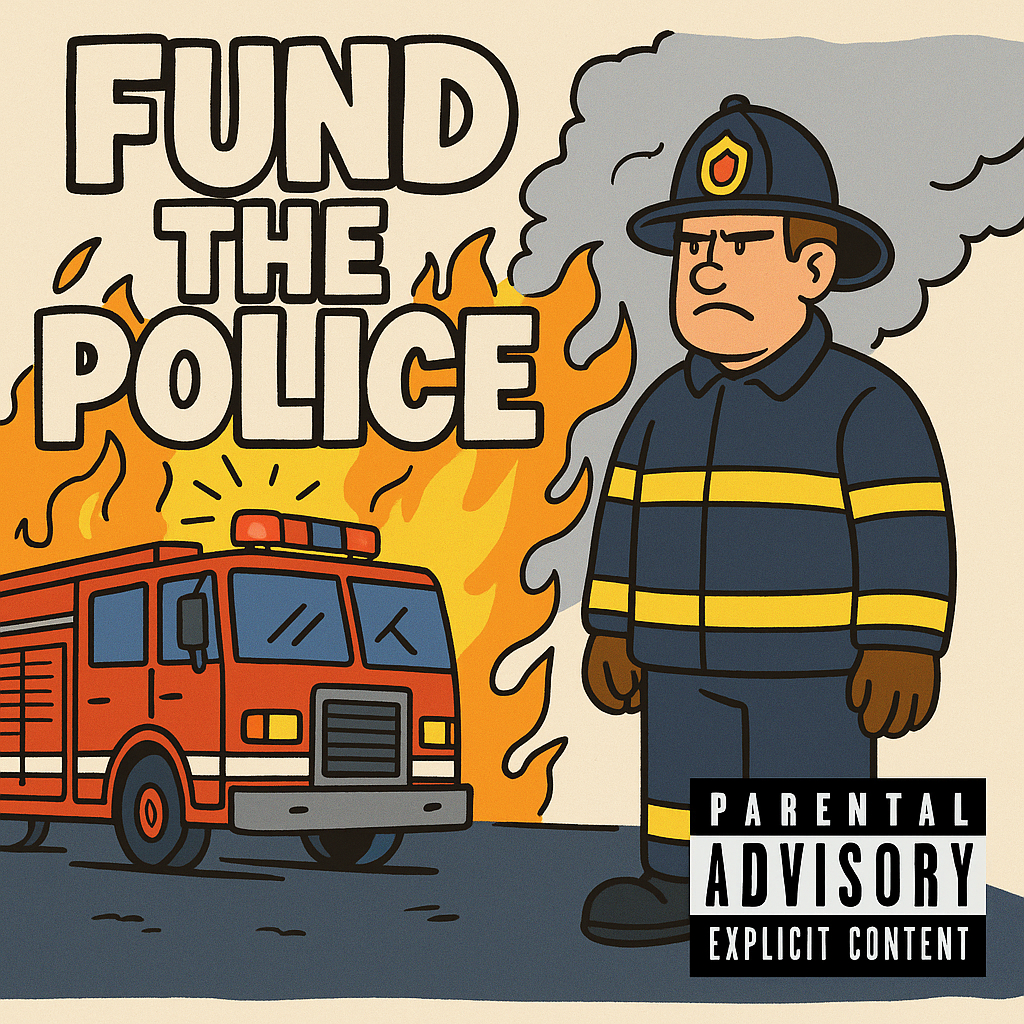
F*** The Fire Department

🎤 

(N.W.A style – verse-heavy, raw, aggressive beat)

[Intro – Spoken Word]

Yeah, you hear that siren?

Rollin’ up, actin’ like heroes

But they ain’t savin’ nobody on my block…

[Verse 1 – Ice-Cube Style Flow]

F*** the fire department, comin’ in late,

My crib burnin’ down, and they talkin’ ’bout fate.

Pull up slow, sippin’ on coffee,

Talkin’ ’bout permits, man, get off me!

You got a badge and a hose, but no heart,

Let my granny choke in the smoke from the start.

You ain’t a savior, you a staged-up joke,

In my hood, y’all come when the whole block’s toast.

[Verse 2 – Eazy-E Style Flow]

I called 9-1-1, got voicemail,

By the time they came, we in smoke hell.

Truck sittin’ pretty while the flame got lit,

Now my neighbor homeless, and they don’t give a s***.

Roll deep in a rig with a siren on top,

But won’t step foot till the whole thing pop.

Insurance claim, now they playin’ pretend,

Y’all ain’t firefighters, you just wait for the end.

[Chorus – Hook]

F*** the fire department! (Yeah!)

They don’t show up, they just start arguin’.

F*** the fire department! (What?)

My street’s burnin’, they just park and spin.

F*** the fire department!

Ain’t no heroes here — just badges and sin.

[Verse 3 – Dr. Dre Style Flow]

They got axes, but no action,

Camera crews on deck, all distraction.

Pull up flexin’, gear lookin’ clean,

While my fam lost everything, you know what I mean?

This ain’t about the ones who fight real fires,

It’s the ones on payroll just buildin’ empires.

Pensions fat, while the projects roast,

And the chief at a gala makin’ champagne toasts.

[Outro – Spoken Word]

To the ones who really run in when the heat’s up —

Respect.

But for the rest of y’all frontin’?

F*** the fire department

“Stand Up Meetings: The sitcom nobody asked for”

By Edward*, Professional Meeting Attender (sometimes physically, mostly spiritually)

There was a time before the era of banana bread, panic-sourdough, and suspicious mask tans when a “stand-up meeting” meant just that. You stood. Up. Around a whiteboard. Possibly holding a marker you didn’t really know how to use, nodding sagely at a diagram that looked suspiciously like a game of Pictionary gone wrong.

It was a daily ritual. A slightly tepid firestorm of action points, blockers, and Geoff from accounts forgetting why we even met in the first place. It lasted just long enough for everyone to pretend they were busy, but not so long that we got caught admitting we were making it up as we went along. And somehow, despite it all, ideas flowed. Connections sparked. Projects took off. It was like “The Office” but with slightly fewer weird stares and more passive-aggressive Post-it notes.

Then came The Great Disruption.

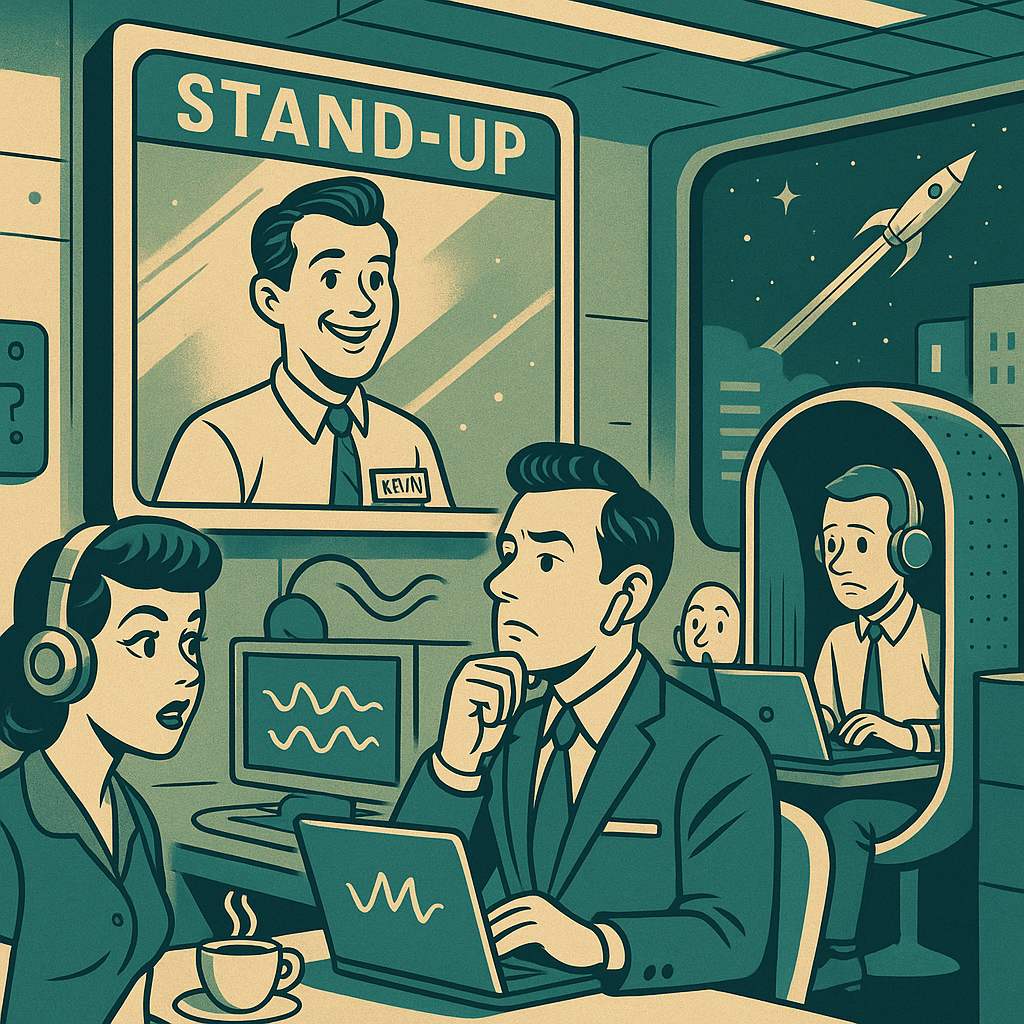
Suddenly, our stand-ups were on Zoom. Now, instead of clustering around a whiteboard, we were all beamed into each other’s lives like nosy aunties. Meetings now featured Rick’s laundry room, Debbie’s dog (who was apparently also a product owner), and someone—possibly Nick—whose wife didn’t understand how virtual backgrounds work. To be fair, none of us will forget that meeting.

And let’s not forget the rise of The Headset Hero. Every stand-up had one: mic fully committed to echoing their soul into the void, eyes shifting like they were defusing a bomb, and the inevitable, “Sorry, could you repeat that? I was buffering.” Buffering? It’s 2025, not a dial-up funeral. We all saw your cursor jump between your three other remote jobs. You’re not fooling anyone, Dave. Or should I say… “Kevin.”

Then came the “Return to the Office” sort of.

Now, we’ve all forgotten how legs work. We still call it a stand-up, but we’re slouched in chairs that definitely don’t meet health and safety. Inexplicably, we sit in the same office, next to the same people, but still talk to them via Zoom. Because it’s “easier.” And Derrick? Derrick’s in a pod. Not a productivity pod. Not even a peas-in-a-pod pod. Just a soundproof chamber of solitude because Paul, who sits behind him, emits feedback strong enough to down a satellite every time he clears his throat.

Meanwhile, Gareth from procurement moved 0.003 miles outside the official “mandatory return radius,” and now apparently exists in a legal grey area somewhere between “WFH rebel” and “digital ghost.” He hasn’t been seen since December. Occasionally a Slack message appears. Possibly automated. Possibly sent by a hamster. No one’s sure.

And let’s not ignore the stand-up paradox: why do we now have two teams doing the same stand-up—one remote, one in-office—and everyone’s still confused? Why are we waving at screens when the actual human being is two desks down? Why is Kevin the only one who knows what’s going on, and how did he become the Minister of Meeting Attendance without anyone noticing?

Honestly, the BBC couldn’t write this. But if they did, it would star a flustered middle manager, a smug work-from-homer in a kimono, and an intern who accidentally screen shares their desktop filled with nothing but “Draft Presentation FINAL (2).pptx.”

So what’s the moral?

Maybe it’s this: the post-COVID office isn’t broken—it’s just been rewritten by a drunk sitcom writer who’s still convinced we all live in 2005. And frankly, I’m here for it.

Just don’t ask me to stand up.

I’ve already committed to the slouch.

The Golden Years: Reclaiming Control of the Wild Wee Stream

You know you’re getting older when your body starts doing weird things—like making random noises when you sit down or thinking about your cholesterol while eating cheese. But nothing quite prepared me for the day I realized… my pee stream had gone rogue.

Once upon a time, my aim was a precision-guided missile. I could walk into a restroom and confidently send that stream right down the centerline like a stealth pilot on final approach. Now? It’s more like turning on a garden hose that someone’s kinked halfway through. Sometimes it sprays with force. Sometimes it dribbles like a leaky faucet. Occasionally, it splits like Moses parting the Red Sea.

Public urinals have become splash zones. If you’ve ever used the picnic site facilities off a motorway and looked down in horror to see your shoes glistening—that’s not dew, my friend—then you know the struggle. It’s a terrifying game of “point and pray,” and the odds are never in your favor.

I thought I was alone in this awkward bathroom ballet until I was watching an episode of Bluey (yes, that animated dog show has reached guru status in our household), and boom—there it was. A cheeky reference to “splash back” from dad-dog Bandit. At that moment, I felt seen. Validated. Not alone in the golden wilderness.

So, is this common?

Apparently—yes! As men age, a few things happen:

• The prostate gets a bit bigger and squeezes the urethra. Fun!

• The bladder doesn’t contract as strongly.

• The urethral opening might shift slightly, especially after a lifetime of wear and tear. (Insert tragic violin here.)

Basically, your once laser-focused superpower starts behaving more like an unpredictable fire sprinkler on its last legs.

Solutions for the Rogue Stream

Let’s get into some techniques and tips—because dignity, dry shoes, and bathroom confidence can be restored.

1. The “Triple-Tap Test”

Before you unleash the stream, give things a gentle nudge or shake. Sometimes there’s a slight blockage or stickiness (we’re being honest here). A couple of taps can ensure things start off in one direction, not three.

2. Aim for the Sweet Spot

Don’t go for the urinal cake or the loud back wall. Hit the side wall, at an angle. Think geometry, not brute force. You’re looking for a silent, splash-free arc. Like a ninja. Not a firefighter.

3. Foot Positioning is Key

Stand slightly back, feet apart. This isn’t a pistol duel at high noon—it’s a defensive strategy. Shoes too close? They’re getting wet. Turn toes out slightly. Just enough to clear the danger zone.

4. The Sit-Down Revolution

Yep. Go ahead and gasp, but many guys are embracing the seated pee—especially at home. No mess, no stress, no second mop-up operation. And frankly, after a long day, it’s downright luxurious.

5. Regular Plumbing Checks

If things are wildly unpredictable or weak, go see a doc. A quick prostate check or urinary flow test could rule out anything serious. Better safe than soggy.

6. Portable “Splash Guards” for the Wild

If you’re out camping or in sketchy public toilets, keep tissues or paper handy. A little layer inside the urinal (or toilet bowl) can soften the splash-back recoil. Bonus: it feels like a mission, not just a wee.

Final Thought: Let’s Talk About It

Bathroom shame needs to stop. We talk about cholesterol, receding hairlines, and joint pain—but not the chaos of aging pee streams? Enough is enough. Let’s open the urinal-door to honest conversation.

So, to the men out there navigating the golden turbulence of the later years: you’re not alone. You’re not broken. And with a little finesse, you can reclaim control of the splash.

Just… maybe wear darker shoes when you’re out. Just in case.

Pee responsibly. Share with a friend. And aim true, brave warrior.